

Wallering Around in Austin’s History
By Martha Ann Hartzog
Festivals of Yore Series
Whoever in the audience has heard of “The San Sam Festival” of Austin? Raise your hands. Not so many, I predict! What an interesting name, “San Sam.” It predates the madness of SXSW or ACL, the two giant internationally-known festivals that crowd our streets in the Spring and Fall.
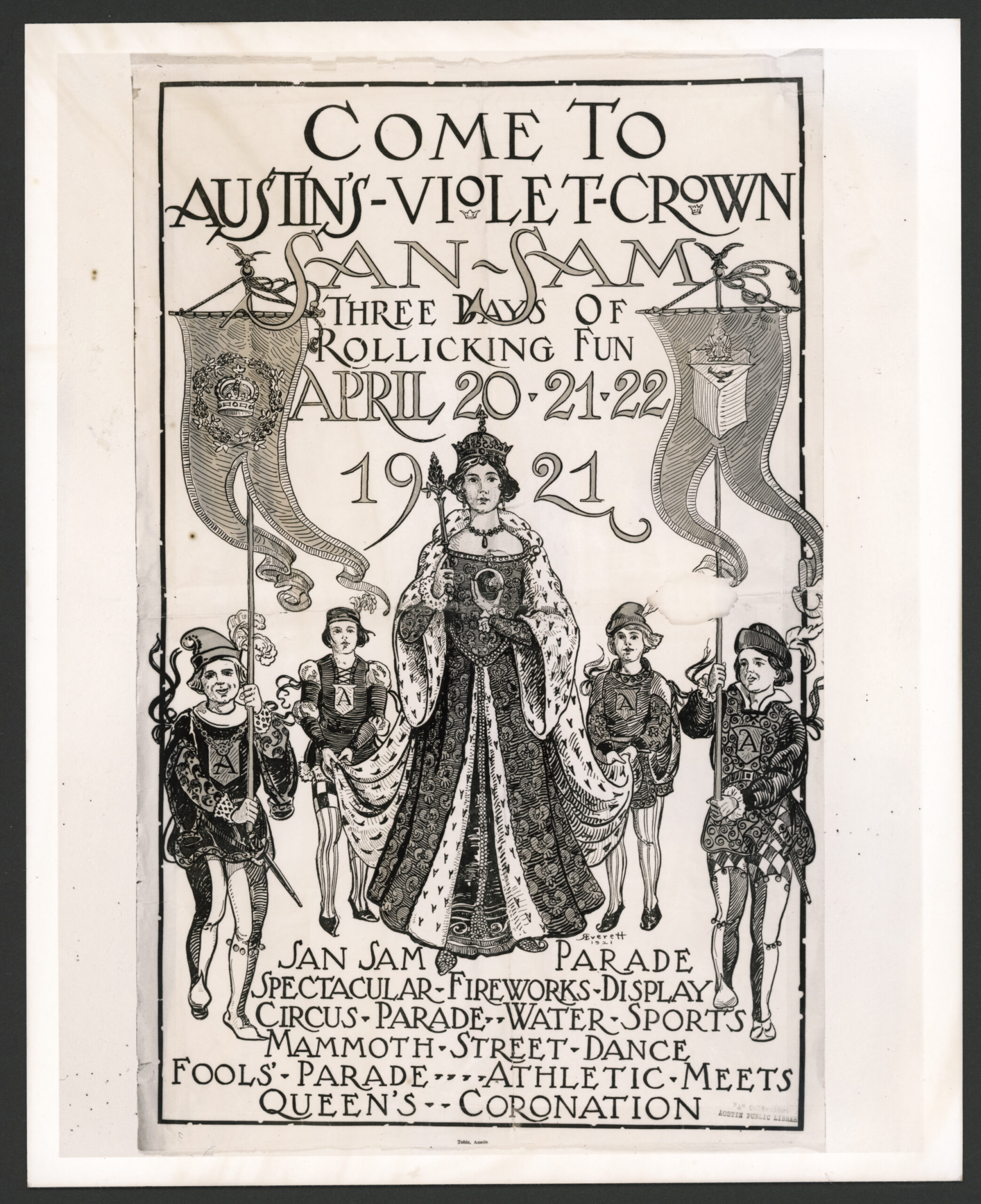
Take yourself back 100 years to the storied 1920s. It was the time of flappers in short dresses doing the Charleston, bathtub gin, and speakeasies. In 1920, a very select Austin organization, the “Order of the Violet Crown,” a name referring to attributes assigned to Austin (the origin of the name “Violet Crown” having been described in another “Wallering” column), felt that Austin needed a festival to rival “Fiesta” in San Antonio. The Austin Lions Club came up with the idea and suggested and that it should be held in April to commemorate San Jacinto Day. The festival name was to be decided by a competition. A $10 prize (today almost $200.00), was offered to the person with the winning name. Mrs. A. W. Harper came up with “The San Sam Festival,” named in honor of the Texan’s victory at the Battle of San Jacinto in April, 1836, commanded by then General Sam Houston.
It should be noted, in a bit of an aside, that fancy dress balls celebrating the victory at San Jacinto began to be held throughout much of settled Texas beginning the very year after the battle! Houston, at that time the capital of the Republic of Texas, was the site of the 1837 San Jacinto Ball. Naturally, President Elect Sam Houston was the most prominent guest at the ball. He was still favoring his ankle, which had been wounded at the battle of San Jacinto, but apparently gallantly danced the night away with various “belles.” Sam was known for his fanciful outfits. At this ball he wore a ruffled shirt, scarlet cashmere waistcoat, and a suit of black silk velvet, corded with gold. Silver spurs adorned the heels of his red-topped boots.
Back to the “San Sam” Festival, which lasted for four years, namely 1920, 1921, 1922, and 1923. Traditional festivals all over the world seem to share the same characteristics: participation by local luminaries and prominent organizations, a grand parade, a ball, a queen and her court, and finally various associated activities, such as a monstrous fireworks display. The “San Sam” Festival was no exception. Each year it featured an exotic theme for the “court”: British India, the Orient, Spain.
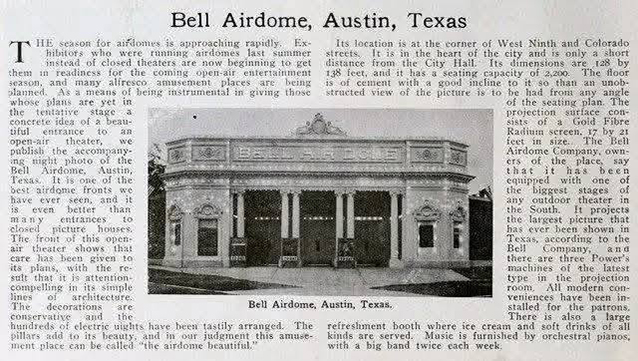
A complete program exists for the 1921 festival. What an elaborate succession of events. The kickoff was Wednesday, April 20th, featuring a comic parade up Congress Avenue, a band concert, a fire and water display, a boxing exhibition with music, a street dance, and a midway carnival by the Kiwanis Club. The next day, Tuesday, April 21st, a Varsity Parade was led by the Longhorn Band. Newport Follies took place at the Bell Air Dome with “60 beautiful University Girls.” The Bell Air Dome was the first silent film theater in Austin, located at W. 9th and Colorado Streets. a Varsity Water Fete was held at Deep Eddy Bathing Beach. In the evening a Varsity Circus and then a Sham Battle of San Jacinto took place at Clark Field.
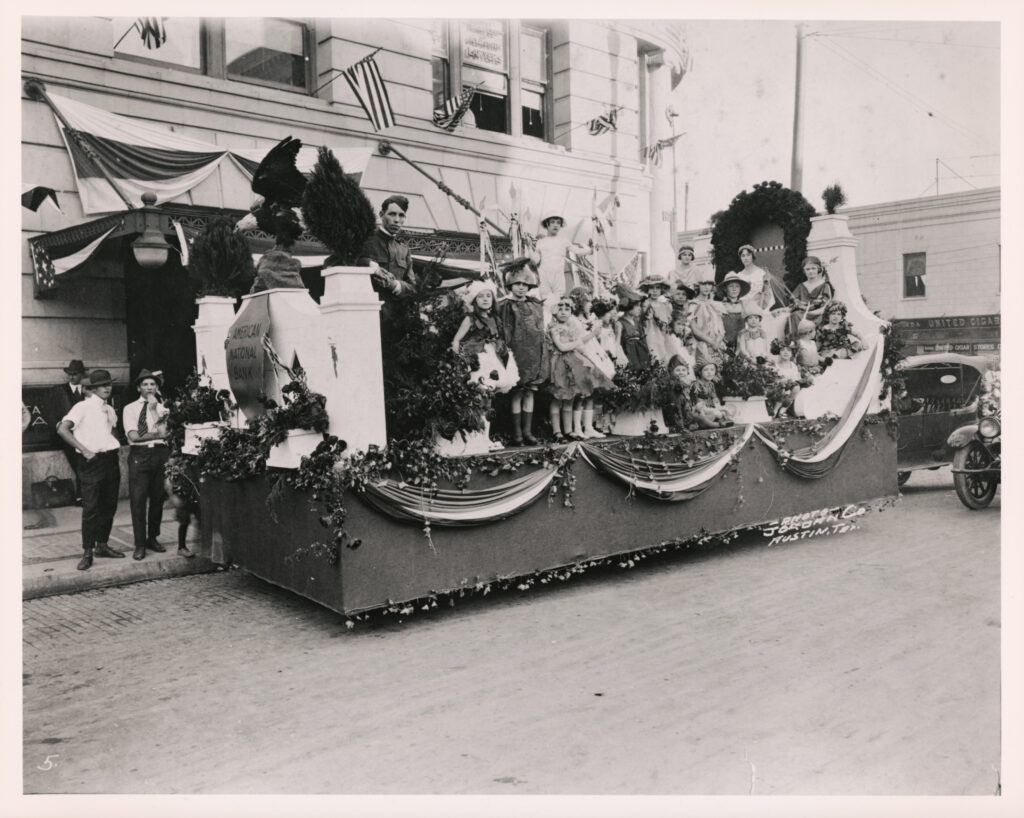
Are you exhausted yet? On the morning of Friday, April 22, there was a Water Carnival at Deep Eddy with a diving and swimming contest, also boat racing, presumably on the Colorado River. In the afternoon there was the Grand San Sam Parade led by the Ben Hur Band, with the University and Shrine Drum Corps bands. Finally, in the evening, there was the Coronation of the San Sam Queen at Woolridge Park, followed by the Queen’s Ball at the Driskill Hotel. R. Niles Graham, descendant of Governor and Mrs. Elisha Marshall Pease, was the ball’s chairman. Festival organizers expected an of attendance 30,000 people. Maybe this was a tad over-optimistic. In 1921, the total population of Austin was only 35,000, and it is doubtful that every single Austinite attended.
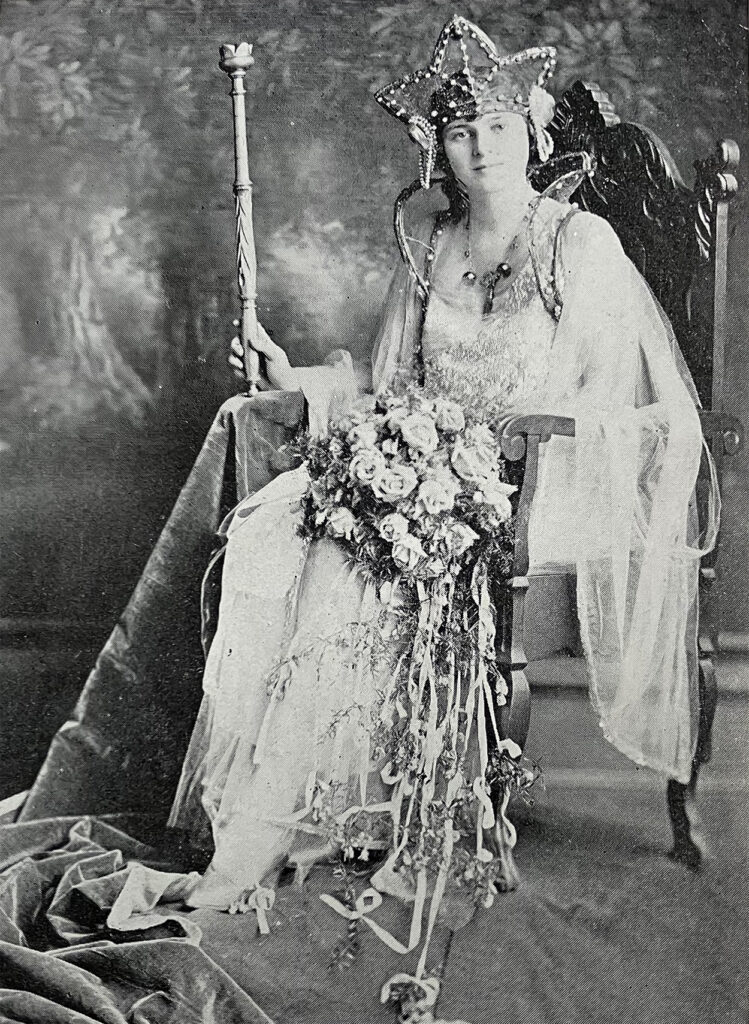
Although there is no photograph of the 1921 queen, there is one for the 1920 Queen. Miss Mildred Griffith is wearing a lovely gown, apparently made of silk chiffon or perhaps silk netting. Chiffon is French for cloth. It’s an elegant, sheer fabric with a soft, beautiful drape, perfect for layering. Silk netting would provide a lively top layer. A small version of the Elizabethan collar held up by a wire frame rises from her shoulders and curves around the back of her neck. Miss Griffith’s elaborate bouquet is obviously roses. From the roses hang a multitude of ribbons, each festooned with smaller roses. Her scepter is a carved wooden staff. Her crown… oh, her crown! Obviously, it is the top three points of the five-pointed Texas Star. The queen sits regally in a heavy Victorian style chair. One can only assume that in 1921 and 1922, the queens’ gowns were similarly spectacular. Were they perhaps preserved by the families?
The final San Sam Festival took place in the Fall of 1923 to coincide with the Texas State Exposition, which was held in Austin for several years. According to the Handbook of Texas, “For the 1923 Texas State Exposition, held at Camp Mabry, an enormous firecracker—at the time, the world’s largest on record at ninety feet long and featuring ‘100,000 smaller crackers of various sizes and flares and pinwheels of all colors’—was brought from China and exploded before an enthusiastic crowd.”
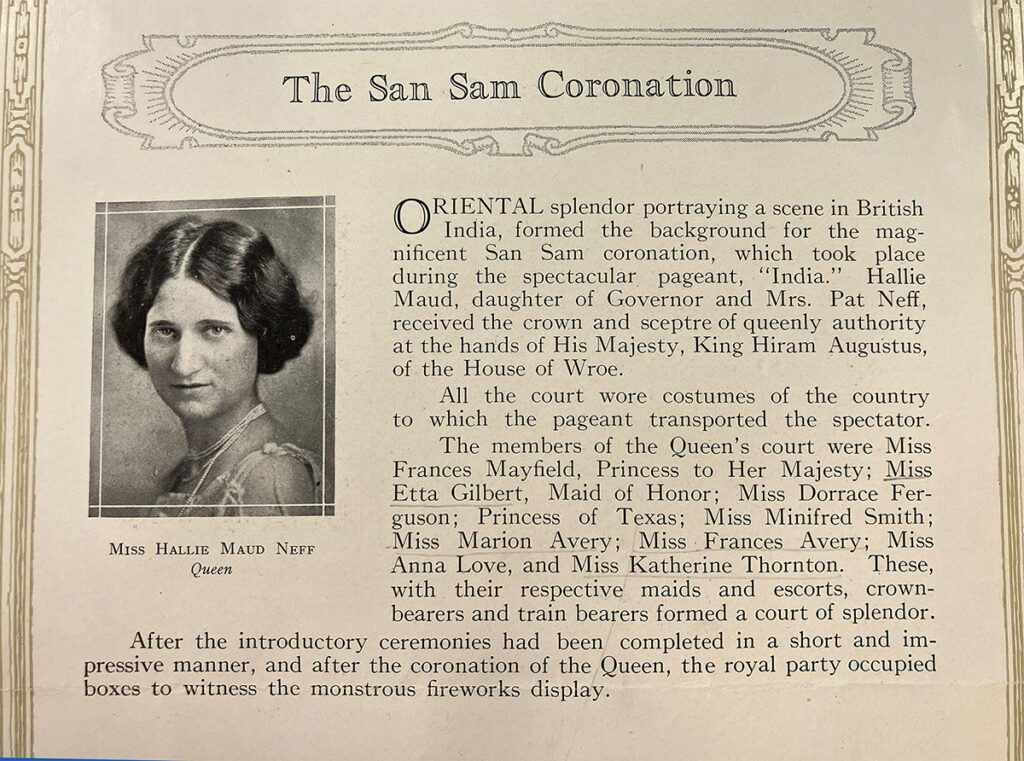
For 1923, fortunately we have a description of the Queen’s Coronation. The theme was “British India,” quite exotic indeed. Miss Hallie Maud Neff, the daughter of Governor and Mrs. Pat Neff, received the crown and sceptre of queenly authority. All the court wore costumes inspired by India. Sadly, there are no descriptions. After the coronation the court retired to boxes to witness another fireworks display. It is surprising that there no knights jousting up Congress Avenue in full armor.
Austin was left without a major festival until 1962, when the Austin Aqua Festival was created. More about that in a subsequent article for the projected “Festival of Yore” series.
Sources:
Thanks to The Austin History Center for information on the San Sam Festival and for its images and especially to Katherine Drake Hart, one of the founders of the Austin History Center (then called The Austin-Travis County Collection), and the first Director of the Austin-Travis County Collection, who wrote an article in the “Waterloo Scrapbook” column on the San Sam Festival which appeared in the Austin American Statesman, April 11 1970.
For the description of Sam Houston’s fancy outfit at the first San Jacinto Ball, the writer is indebted to Francis R. Lubbock’s lively autobiography, Six Decades in Texas: (Austin: Ben C. Jones, 1900; rpt., 2017 by Facsimile Publishers).
For the charming photo of the Bell Airdome, Austin, Texas, thanks to Facebook post in Austin Memories, by Lorenzo D., February 14, 2026
For the description of the giant firecracker from China, the quote is from Vivian Elizabeth Smyrl, Revised by Sarah Benson, “Camp Mabry,” Handbook of Texas Online, accessed June 06, 2026, https://www.tshaonline.org/handbook/entries/camp-mabry.
Martha explains her column's title:
Here's why I am calling my column “Wallering Around in Austin’s History.” Partly, it’s a tribute to Edwin Waller, the man who led the planning of Austin, and partly it’s a joke on me. All I ever seem to do is “waller” around in history, not just Austin history, but about all history. “Waller” is how we in Texas pronounce “wallow.” Like in “hog waller.” When you consult the dictionary, you see that “wallow” is a verb meaning to roll about or lie in; to luxuriate or revel in; to flounder about; to billow forth. That’s all I seem to do these days in the always-absorbing realm of what went before.