

Dr. James “Jamie” Pennebaker
Dr. James “Jamie” Pennebaker, professor emeritus at the University of Texas, has a resume that is, to say the least, impressive. He was elected to the National Academy of Sciences, serves as President of the Association for Psychological Science, was elected to the American Academy of Arts and Sciences, and recently held a Fulbright Fellowship that took him to the Czech Republic. He has authored 12 books and over 300 articles on psychology, linguistics, and health. It goes on from there.
All of that started in 1970 when he visited Austin and went to the University Co-Op. He found a large introduction to psychology book in a $1 bin and, after reading it, decided that he had finally discovered his field of study. In his words, he became a psychologist, the way he’s done everything during his career – he stumbled into it.
A few months later, he transferred to Eckerd College in Florida as a junior. Rather than take Introductory Psychology, he implored the instructor to give him the final exam. He aced it, and realized what his academic course of study would be.
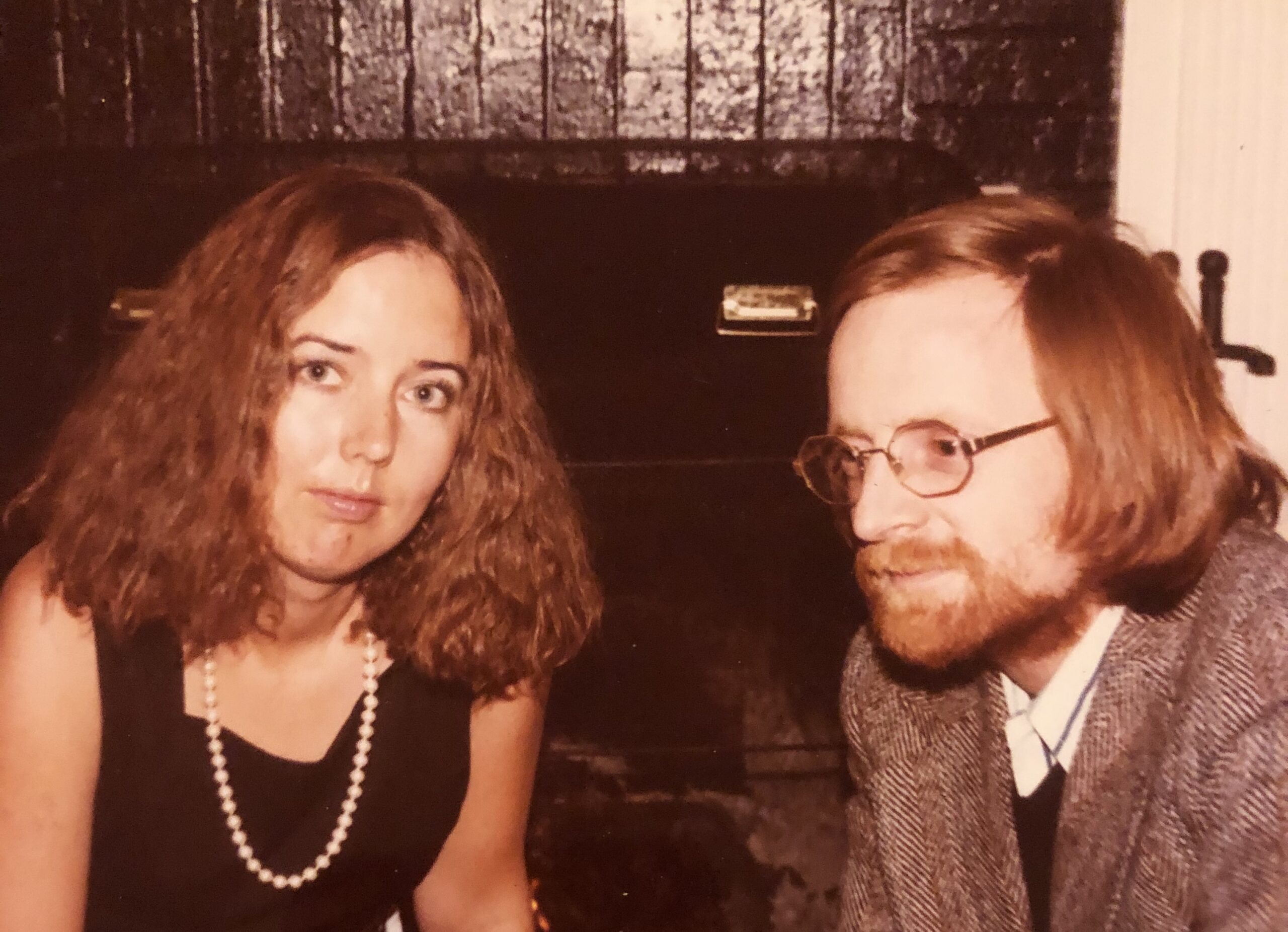
After graduating from Eckerd in 1972, he and his wife, Ruth, were seeking their next step in their academic careers. She decided to attend law school, and he was set on graduate school in psychology. She graduated from UT Law, and he earned his PhD.
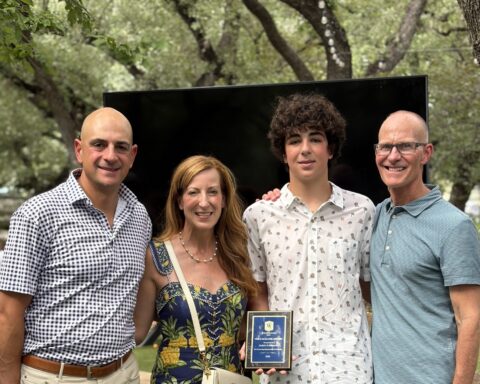
In 1977, they left Austin for Charlottesville, Virginia, when he took a professorship at the University of Virginia. They moved to Dallas in 1983 when Jamie was recruited by SMU, and his career hit a sharp upswing. Then, after 14 years at SMU, UT came calling for his services – and Jamie and Ruth couldn’t resist moving back to Austin. In 1997, they bought a house on Gilbert Street in Tarrytown, and both of their children enrolled in Austin High. “We have been fortunate to have had two wonderful children, Teal and Nick, who are enterprising, thoughtful, and fun,” Jamie says. “And they both have a daughter and a son.” He and Ruth have now moved downtown to a high-rise residence.
It would be impossible to summarize all of Jamie’s career in this column – but two of his ideas have had a major impact. The first was the discovery of expressive writing. Early in his career, Jamie discovered that people who were keeping major life secrets were at higher risk for both physical and mental health problems. It made him wonder if their health could improve if they talked or wrote about these secrets. Across several experiments, he found that asking people to write about emotional upheavals – even if it was only 15-20 minutes a day for three or four days – brought about meaningful improvements in health. They went to the doctor less, various immune markers improved, they slept better, they even made better grades in college. Since the first studies, over 2,000 expressive writing studies have been run in labs around the world.
The second big idea grew out of the first one. In the expressive writing studies, Jamie noticed that not everyone benefitted from writing. He wondered if it was possible to identify healthy writing. Getting human judges to identify healthy writing was not practical. He needed a computer program to do it for him. It was 1992 and no desktop text analysis program existed. Jamie had taken FORTRAN in college and had an idea how such a program could work. Working with one of his star graduate students who had majored in computer science when she was an undergraduate, they built such a program. The program (called LIWC) worked but revealed much more than healthy writing. Jamie realized that by analyzing people’s everyday language, you could learn a lot about their personality, social behaviors, stress levels, and their emotions. This program served to determine if someone was depressed, lying, or telling the truth, among other things. The work became influential in the social sciences, and he has used it to help law enforcement, businesses, and professionals in other fields.
In his career at UT, Jamie was the chair of the Psychology Department from 2005 to 2014. He helped to radically change the way Introductory Psychology was taught, making it into a TV-show format that proved to be quite popular but extremely rigorous. In fact, his teaching model is now used across multiple departments for very large courses. Jamie retired three years ago but is still writing books and doing research on language and other topics. In his words, he’s a “bit of a bureaucrat" with the Association for Psychological Science these days. He points out that there is now a trend: people are not joining academic and professional societies at the same rates as they used to. On that score, he pointed to the book “Bowling Alone” which details how people in the country have become joiners at lower rates on all levels of society. As he says, the important questions are “Are we needed?” and “How can we help people in our society?”
All of this leads back to the country's general tone at the national level, which is increasingly questioning the role of academics and science. Jamie notes that for anyone in a university science program, this is a “scary time.” If the goal is to have a healthy Texas and America, it’s important to know that science can provide trustworthy results. Every academic field is under stress. On top of that, the world is having to come to terms with the artificial intelligence revolution – something that is wonderfully exciting and also deeply troubling. “It’s a period of massive transitions.”
Note from Forrest Preece
I’m afraid that my story about Jamie and his work is sounding dry, so I’ll include a description of his book “The Secret Life of Pronouns: What Our Words Say About Us,” one of the twelve that he has authored. In this book, he analyzes everything from John McCain's tweets to the Federalist Papers. Among other topics, we find out how to predict that a high school student who uses too many verbs in her college admissions essay is likely to earn lower grades in college. The reader also discovers how a world leader's use of pronouns could reliably signal that he might lead his country into war. Would you be interested to know what Lady Gaga and William Butler Yeats have in common? Or how Ebenezer Scrooge's syntax hints at the inner workings of his personality? Buy the book! My point is that Jamie’s work is engaging and full of lively details, making for exciting reading.