

Wallering Around in Austin’s History
By Martha Ann Hartzog
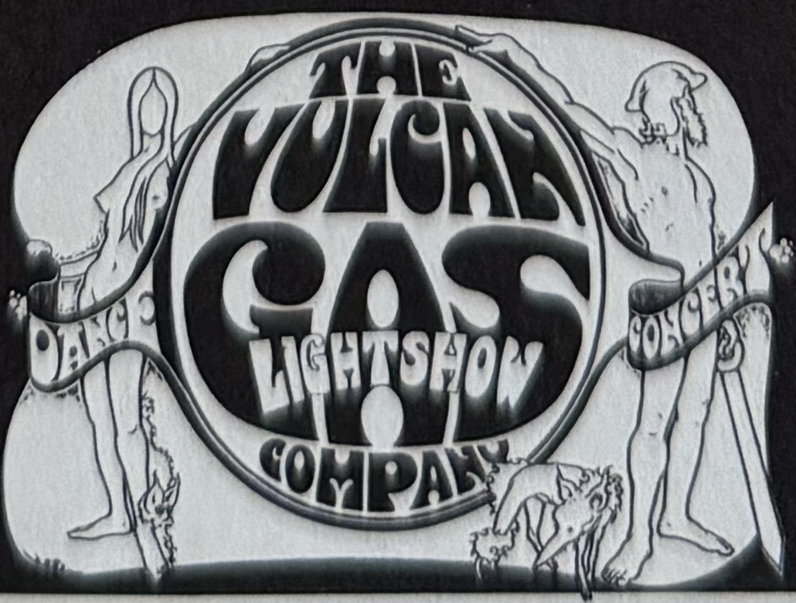
Long, long ago, in a galaxy far away . . . No, wait, that belongs to another story. Let me start again. Long, long ago, in the mists of time, before there was Austin City Limits, before there was South by Southwest, even before Austin was graced by the Chamber of Commerce with the nom de guerre of “Live Music Capitol of the World” . . . No, wait again! There is one more “before”—Before even the famous Armadillo World Headquarters, where the absurd armadillo became a visual symbol for Austin, courtesy of the nimble mind of artist Jim Franklin, there was The Vulcan Gas Company.
In 1967, improbably bursting forth in a then sleepy downtown, was the original Vulcan Gas Company, a small live music venue located at 318 Congress. This was a time when City Fathers were anxiously wringing their hands at the potential abandonment of the capital city’s downtown, signaled by the many vacant storefronts. Austin was still a relatively small town in 1967, with a population of about 224,000, its main source of economic stability precariously perched between The University of Texas and the State Office Complex. It was a time before the great tech revolution transformed downtown Austin into a place of behemoth skyscrapers. Interestingly, 1967 was also the year that IBM opened a major facility to manufacture Selectric typewriters, marking the beginning of the region’s destiny as a tech hub. Fifty-nine years later, Austin is home to the likes of Dell, Apple, Tesla, Oracle, and Google.
How did the Vulcan Gas Company get its name? Here’s a possible theory. Vulcan was the ancient Roman god of fire and metal working. It’s also a hypothetical plant nearest the sun, whose existence was erroneously postulated to account for pertubations in Mercury’s orbit. Was this the inspiration for the name? Certainly, the Vulcan Gas Company represented a pertubation in the received order of the world of the 1960s. For those consulting on-line dictionaries, “pertubation” means “a minor disturbance, change, or deviation in the state, motion, or trajectory of a system.” The Vulcan Gas Company certainly was that.
In the 1960s, Austin was thrumming with small music venues. Among these were the Methodist Student Center on the University of Texas Drag, where Janis Joplin’s singing career began to take off, Threadgills in North Austin, the Ritz Theatre on East Sixth Street, and various night spots in East Austin like the IL Club, where the Blues reigned supreme. It was a time when the traditional folk music was beginning to be superseded by “rock n’ roll.”
In 1967, a set of young entrepreneurs— Gary Scanlon, Don Hyde, Sandy Lockett, and Houston White— persuaded a downtown building owner, Joe Dacy, to rent them a large, vacant space. The walls had to be painted, the stage created, the lights hung. It was almost the classic “let’s put on a play in the garage!” There were no tables and chairs in the Vulcan, just benches. It was not air conditioned. Unlike today’s concert venues, tickets were cheap. You danced the night away anyway, fueled by the energy of the moment. It is true that although the Vulcan Gas Company did not have a liquor license, there were drugs being consumed on the premises. But what was occurring was so much more.
The Vulcan has been called “Austin’s first hippie mecca.” For many, this has a mixed message. The music venue was a place where the counterculture ideals of peace, experimentation, and independence were expressed. It was a magnet for the young kids who had flocked to Austin from the far reaches of Texas to enjoy what many today still call “the Austin Vibe.” The late 60s was a time of an idealistic rebellion, its reverberations still felt today.
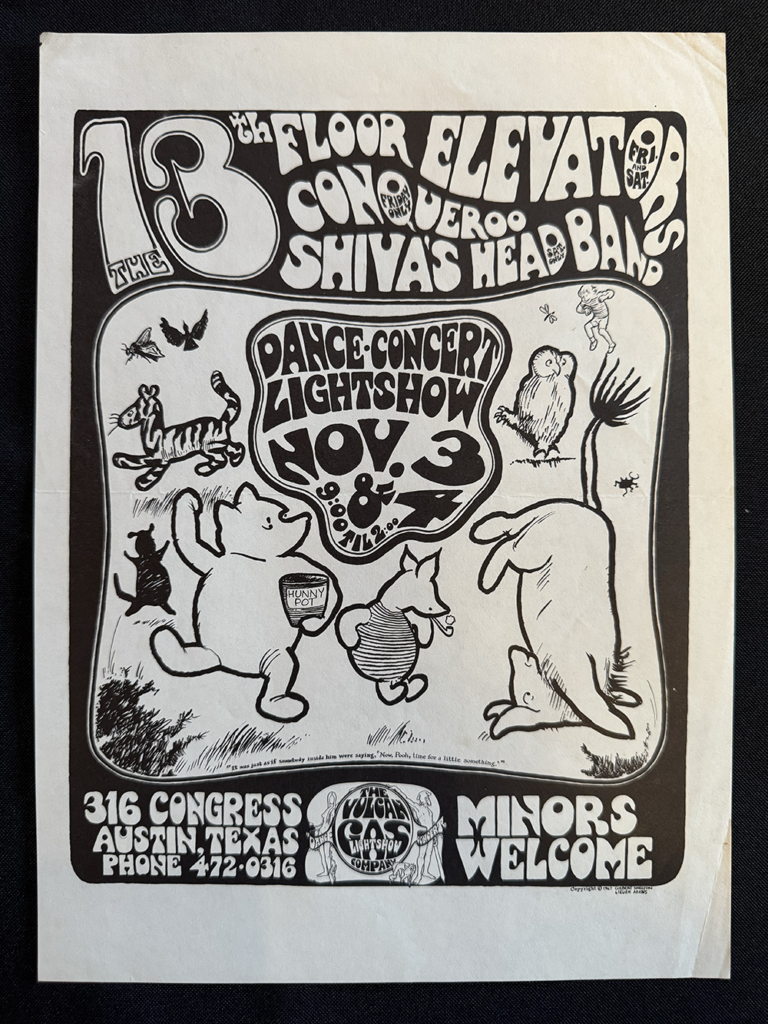
This gumbo of ideas is wonderfully expressed by the poster for a concert featuring the 13th Floor Elevators, Shiva’s Headband, and the Conqueroo, all regulars at The Vulcan Gas Company. Fanciful names for bands, with interesting meanings embedded. The 13th floor traditionally did not exist in a building, for it signaled bad luck. Shiva is the Indian God of Hinduism, meaning “the kind or good one” and reflecting the increased interest in Eastern religions which was sweeping the youth of the period. A “headband” could sit on the crown of a hat or be a primary music band. “High John the Conqueroo” is both a folk hero and a dried root used on amulets for luck and victory. Combine that with the playful images from A. A. Milne’s childhood classic, “Winnie the Pooh,” and you will have the heady mix that represented the idealistic youth movement of the 1960s.
Another innovation of the Vulcan was its light shows. Has anyone out there attended a large musical event lately? One where the sophisticated light and sound show overwhelms with visual excess? Well, such elaborate shows had their origins in places like the Vulcan Gas Company, where young creatives were striving to change the world through multiple slide projectors combined with liquids of dizzying colors that move and morph across the walls and the stage.
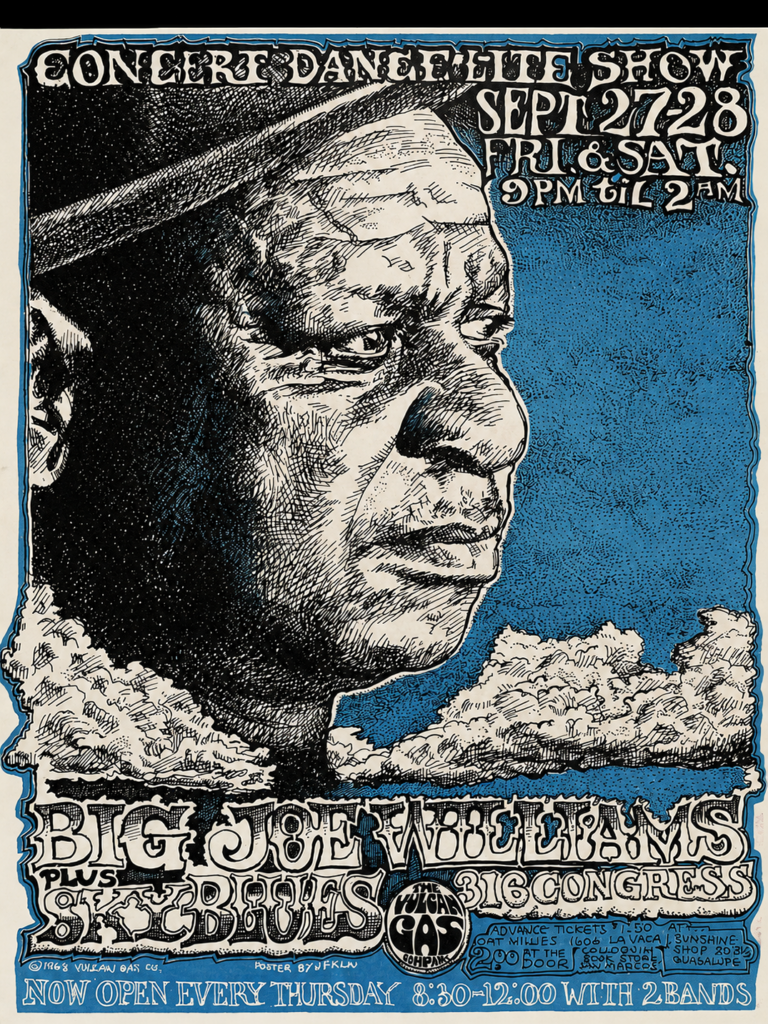
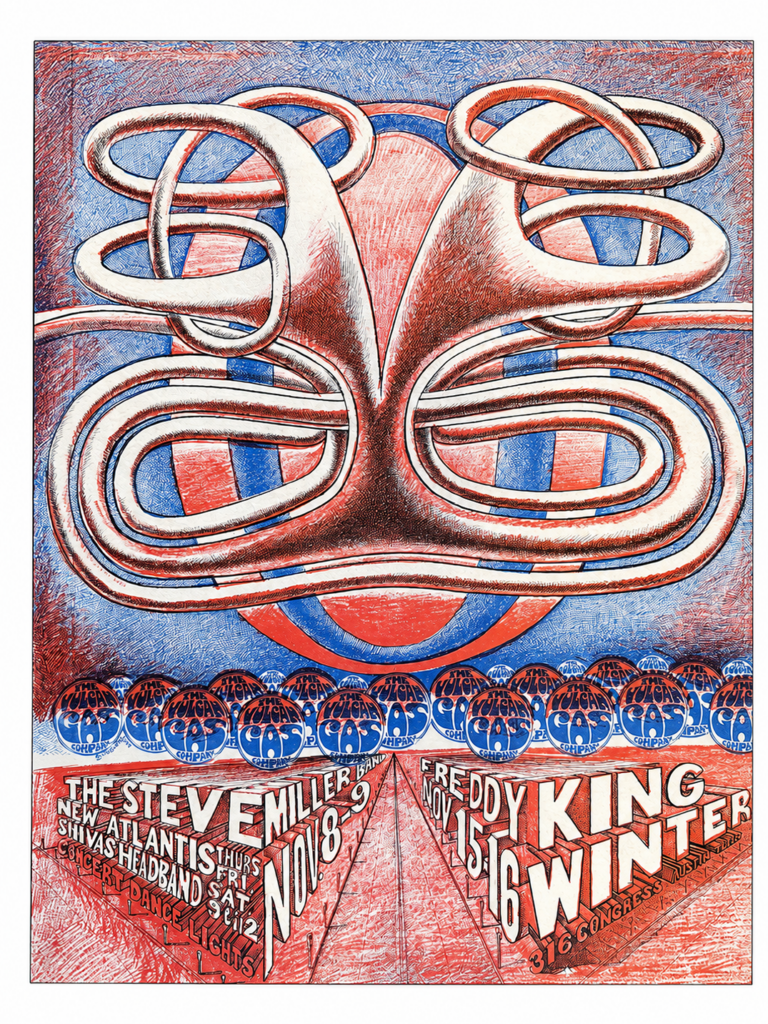
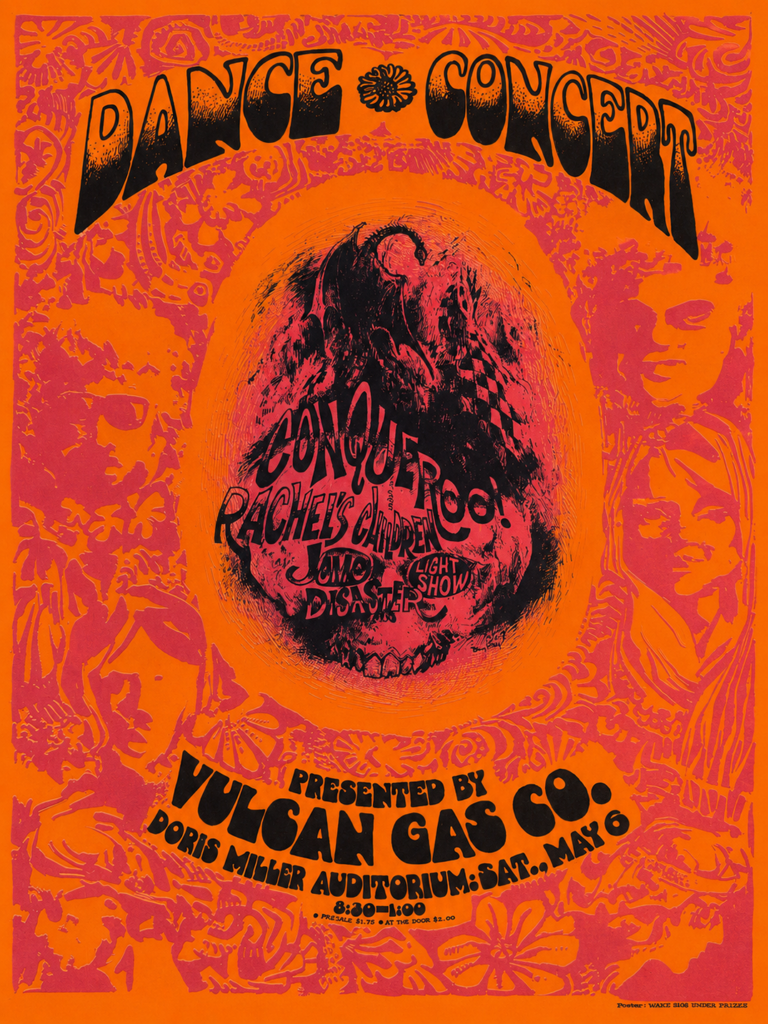
Because the leading Austin daily newspaper refused to publish ads from the Vulcan Gas Company, its primary method of advertising became posters. Visually dramatic posters were churned in out in abandon by such artists as Jim Franklin, Guy Juke, Kerry Awn, Gilbert Shelton, and Danny Garrett. Many of these were inspired by the Art Nouveau style of the early 20th century. Through their sinuous curves and vivid colors, the posters, like the light shows, attempted to simulate the psychedelic experience. They have become a collectible, much copied, genre on their own.
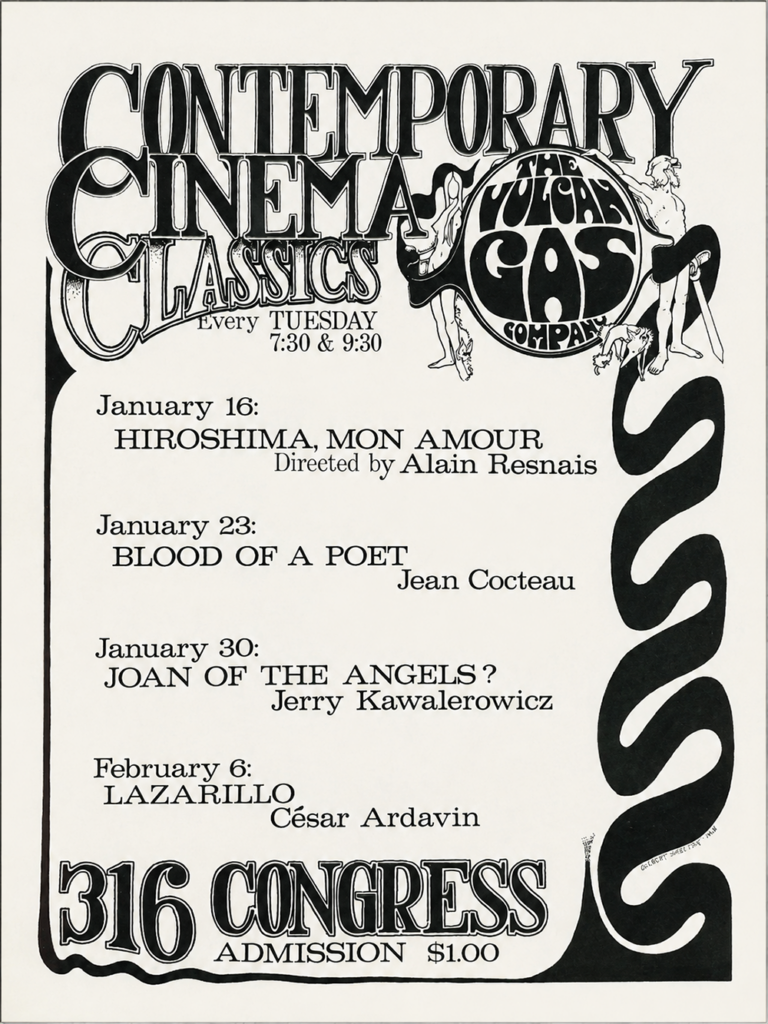
The Vulcan famously mixed musical modalities, notably Rock and Roll with the Blues. This was something the Armadillo World Headquarters later would become popular for accomplishing. Not only were there concerts, but the Vulcan showed classic movies both by the Marx Brothers and the French “new wave,” like those of director Alan Resnais. It also held concerts at other locations, Doris Miller Auditorium in East Austin and the City Coliseum being examples. Of course, it held benefit concerts for young men incarcerated on marijuana charges. It was serving its constituency.
The Vulcan Gas Company began to fail financially after the November 21, 1968, scheduled concert with Janis Jopin and Big Brother and the Holding Company was cancelled due to illness on the part of Janis. The famed performer, who grew up in Port Arthur and saw her career bloom in Austin, was so popular that venue had to be moved from the small Vulcan Gas Company to the Hemisfair Theatre in San Antonio. (She also cancelled concerts in Dallas and Houston that week.) Janis’ cancellation was a disaster for the club, which was always on a financial tightrope. Most of the posters for the event, designed by Jim Franklin, were put in the trash, but a few remain.
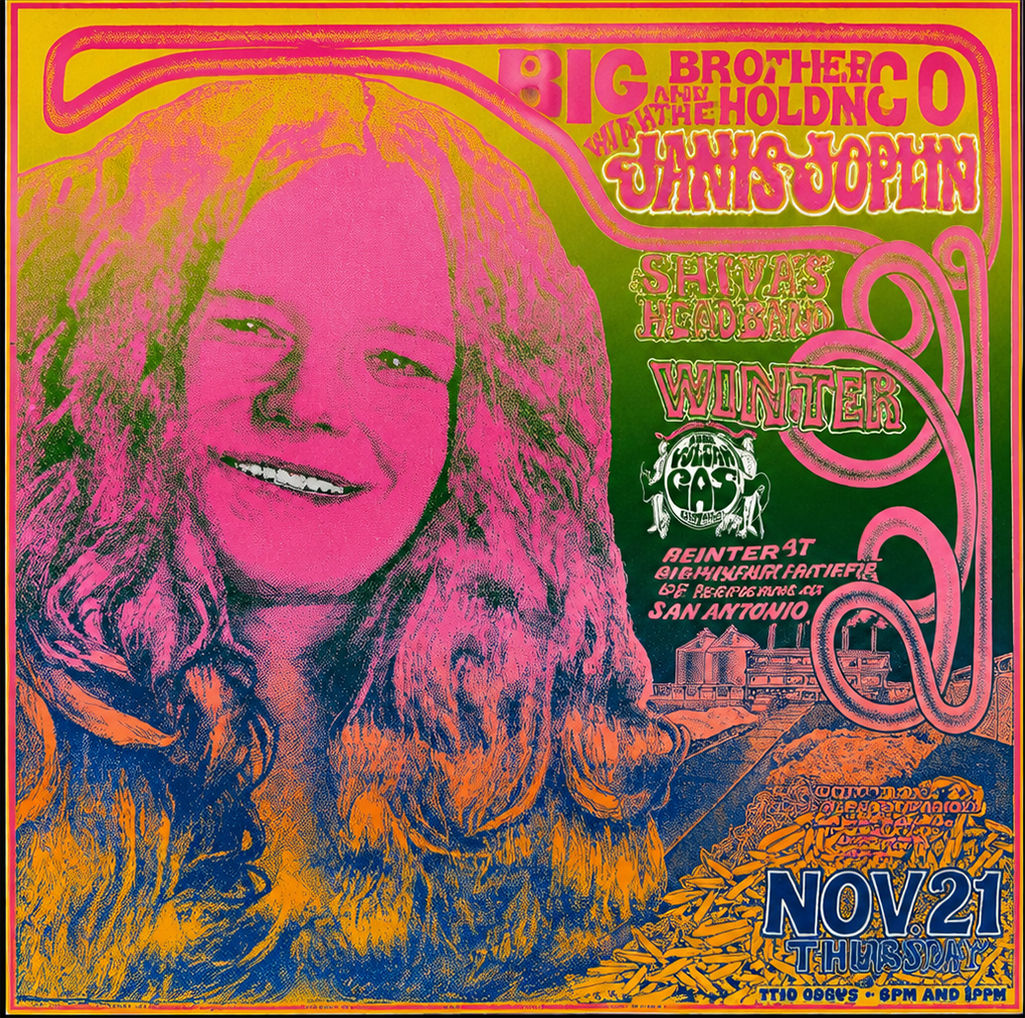
The Vulcan Gas Company closed in May, 1970. It would be a few more months until the Armadillo World Headquarters would be opened by Eddie Wilson. But the story of this creative and spirited era in Austin’s history is not forgotten. It actually gave rise to Austin’s famous sobriquet, “Live Music Capital of the World.” Shortly it seems, a documentary will air on the local PBS station on artist Jim Franklin. “The Spirit of the Vulcan Gas Company Lives.”
Sources:
Corcoran, Michael. “Austin’s first hippie mecca: Vulcan Gas Company.” Michael Corcoran Substack. December 01, 2021. Accessed August 6, 2026.
Corcoran, Michael. “Acid Flashback: Vulcan Gas Company 1967-1970.” December 01, 2021. Michael Corcoran Substack, September 15, 2023. Accessed August 6, 2026.
Personal poster collection from Anonymous.
UT Austin, et.al. “Vulcan Gas Company, 1967-1970.” Clio Your Guide to History. July 8, 2017. Accessed August 6, 2026.
Martha explains her column's title:
Here's why I am calling my column “Wallering Around in Austin’s History.” Partly, it’s a tribute to Edwin Waller, the man who led the planning of Austin, and partly it’s a joke on me. All I ever seem to do is “waller” around in history, not just Austin history, but about all history. “Waller” is how we in Texas pronounce “wallow.” Like in “hog waller.” When you consult the dictionary, you see that “wallow” is a verb meaning to roll about or lie in; to luxuriate or revel in; to flounder about; to billow forth. That’s all I seem to do these days in the always-absorbing realm of what went before.