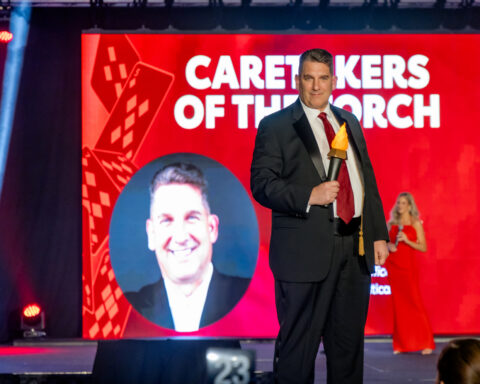



West Austinite Lynne Skinner has racked up success after success in her public relations career, which began in the 1980s. As the saying goes, she “came by it natural.” A bookworm growing up, she devoured fiction and nonfiction and was fascinated by the word choices authors made. By the time she came to Austin and enrolled at the University of Texas, she knew she wanted to tell her own stories. It was only natural that she gravitated toward the journalism and public relations curriculum.
Her favorite professor – Dr. Frank Walsh, who still lives in Pemberton – taught his students how to craft stories for companies, organizations, nonprofits, and governments, and how that process played a role in the news each day. “I found that working with the ‘newsmakers’ – getting inside the heads of leaders, and in the guts of an organization – was far more fascinating than just reporting on it,” Lynne says.
After getting her start with an internship at the Austin Aqua Festival, and then an account executive position at a local advertising and public relations firm, Lynne became the Director of Business Development and International Marketing with the Austin Chamber of Commerce Economic Development Division in 1991. Her work there involved promoting The Capital City as a great place to do business, both through media and directly with corporations. She is still proud of the work their “small-but-mighty team” did to rally community leaders for each corporate site selection team they pitched.
Going National
Her first client was Apple Computer. She worked with Angelos Angelou and others at the chamber to recruit that company’s U.S. Customer Support Center of 250 employees, a major coup. That was the beginning of a long relationship. Lynne says that they ate more barbecue and Tex-Mex “than humanly possible” with the Apple team while winning the account. Meanwhile, they ran full tilt to create a love affair between Austin and the national media.
With her significant accomplishments at the chamber under her belt, Lynne was tapped to run GCI Read-Poland/a WPP Company – a firm with 40-plus bright young PR professionals handling over 40 clients. One of their major efforts was serving multiple Dell Computer clients – such as enterprise, small business, corporate and public affairs, and environmental. Ultimately, they consolidated the work of hundreds of agencies worldwide that served Dell’s communications efforts into one at WPP—a stunning success.
One story from that era will always be foremost in Lynne’s mind. On September 1, 2005 – two days after Hurricane Katrina devastated New Orleans, United Airlines initiated “Operation Air Care,” sending humanitarian aid to the stricken area.
The airline delivered food, water, paramedics, medical recovery workers, and more to NOLA, and then airlifted people – including a planeload of amputees – to ABIA and San Antonio’s Lackland AFB.
The head of PR at United Airlines urgently asked their agency to handle the stories – from working with the press to monitoring the needs of evacuees and determining what more they could do. With one of her colleagues, Lynne stood on the ABIA tarmac for hours, doing everything she could to facilitate the operations. She says that it was one of the most gut-wrenching days of her life.
The Austin Cup
Lynne and I have known each other for decades, and we started emailing after I posted something on Facebook about Robert Putnam's popular sociology book Bowling Alone: The Collapse and Revival of American Community, which brings a mountain of research to bear on declining social engagement in the USA. Lynne’s story on this score dates back to 1999, when she was working for the legendary venture capital firm Austin Ventures. The partners had asked her to devise a way to engage their portfolio companies – get them together after hours. In typical overachieving Lynne Skinner fashion, she developed an idea with serious staying power.
Here is her backstory on the idea. “My parents met at a corporate bowling tournament in St. Louis. My dad and my mom’s father (my grandpa) were two standout athletes in their company, and not only bowled together but also golfed and played softball on the corporate teams. My grandma brought her then-20-year-old daughter to the big tournament because she had wanted her to meet the young engineer studying at Washington University. The rest is history. But those corporate teams were a big deal in the Midwest, and my dad and grandpa had won a lot of trophies together. Those stories were part of our family history. And even though we moved to Texas when I was a toddler, our game room held shelves of trophies.”
Drawing on her family’s stories, Lynne says that the idea of corporate teams and the social capital they created both within companies and in the business community was always compelling to her. In an “aha! moment,” she decided to create an invitation-only bowling tournament where the portfolio firms would go toe-to-toe for an annual trophy.
Before she presented her idea, one Austin Ventures General Partner – also from the Midwest – saw “Bowling Tournament” scribbled on a folder on her desk. He didn’t leave Lynne’s office until she elaborated on the proposal. She told him what she was thinking, and he jumped up and clapped – “That’s it!”
He gave her the green light, and it was full speed ahead. For the next 15 years, Austin Ventures underwrote the cost of The Austin Cup until the firm dissolved in 2016. Lynne says that from the beginning, however, they expanded the invitation list to include all technology companies in the region and set out on a mission to more deliberately build stronger social capital within this community.
They created very specific awards encouraging internal participation, external fundraising, and so on. Engaging more tech employees in the giving process and highlighting the impact they had each year created a movement. While preparing for the first event held in February 2001, Putnam’s book was released. Lynne ran out and bought it, and she is still fascinated by it. Parts of it read like what you’d expect from the Harvard professor he is -- providing data, indexes, and proof points – but it offers brilliant insights into social changes that both diminish and build social capital in communities.
Since 2001, The Austin Cup has hosted 161 different technology companies, fielding 706 teams and 3,530 bowlers. Thousands of fans have filled bowling alley concourses year after year for the tourneys. Collectively, they raised over $1.25 million for the Center for Child Protection, and in 2008, The National Children’s Alliance presented Lynne’s team with the Volunteer Leadership Award in Washington, D.C.
Lynne says that their big 20th Anniversary event was scheduled for April 18, 2020, but the COVID pandemic quashed that. For a few years, companies didn’t allow employees to gather in public places, and the tournament was shelved. “Our bowlers and company executives (sometimes one and the same) have been clamoring to bring it back,” Lynne says. She is fervently working on a restart.
Just a couple of notes about Lynne’s personal life. She has had her toes in a lot of different waters—agencies, corporations, consulting, economic development—yet has always shared her talent outside her paid job. She is a strong proponent of skills-based volunteering and encourages everyone to help nonprofits however they can.
Also, Lynne has lived in West Austin for 30 years. Both of her daughters – Taylor (AHS ’11) and Daisy (AHS ’20) – went to Casis, O. Henry, and Austin High. She points out that she was very deliberate about raising her girls in a neighborhood where people were actively working to better their community. “In hindsight, I was a smart cookie.”