

“Edwin Waller: Ever Ready with Pen or Rifle”
By Martha Ann Hartzog
Who was Edwin Waller? Why was he important to Austin? Answer: He was in charge of preparing the city plan for the 1839 Republic of Texas capital, at the behest of President Mirabeau B. Lamar. There were many sites for the early capitals of the Republic. It moved around quite a bit. When Lamar was elected, he selected Austin, originally the hamlet of Waterloo. If you go downtown or you drive up the wide boulevard that is Congress Avenue, you are experiencing the grid system and the beautiful main thoroughfare that Waller laid out.
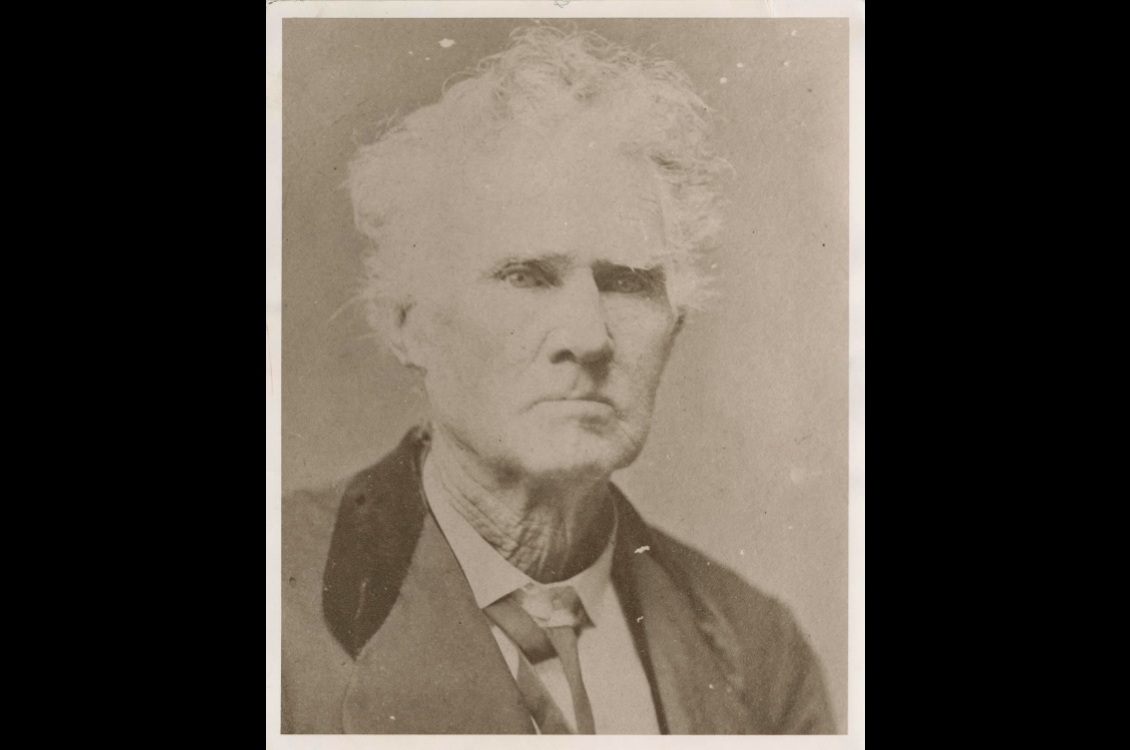
Before explaining Edwin Waller’s plan, let us see exactly who Waller was and what part he played in the drama of early Texas history. During his lifetime, Waller did much more than make a plan and survey lots. Like many, he had caught the “Texas Fever,” and he was in the thick of things as the Texians strove to become independent of Mexico.
Back to Edwin Waller. There’s only space to mention the high points of his story. He was born in Spotsylvania County, Virginia in 1800. He married fellow Virginian Juliet M. de Shields. They ultimately had seven children. When Waller was 31 years old, he arrived in Texas. It is the familiar tale of “moving west” from the old United States in search of better economic opportunities, like more land, or else, just “puredee” in search of adventure.
Waller initially settled in what would become Brazoria County. There he had received a league of land (4,428 acres) from the Mexican government. Up and down along the Brazos River, Oyster Creek, and the San Bernard, other early settlers were beginning to make a living out of their land. They needed to ship hides, beeswax, cotton, and anything else that was saleable. Waller owned the Sabine, a vessel that could generate income by transporting people and goods to the port of Velasco and from there to New Orleans.
These were stormy times indeed in Texas. Velasco would become quite the hotbed for the Texas Revolution. Edwin Waller was in the center of it. Becoming aware of a potential revenue stream, the Mexican government decided to establish a customs port in Velasco. The Texians resented paying the customs duties. When Waller’s ship showed up in 1831, with the first load of cotton produced on the Brazos, he shared that sentiment. Irate, Waller refused to pay. He ordered the ship captain to arm the ship with cotton bales and run the blockade! For this audacious defiance, Waller was subsequently arrested by the Mexican authorities. He wasn’t jailed for very long. But the incident at Velasco became the “Boston Tea Party” for the Texas Revolution. It was widely known as the first act of rebellion against the Mexican government.
Quick on the heels came the next flare-up — the 1832 Battle of Velasco, another example of “bold disobedience.” Predictably, Waller was a participant. The Texians were trying to sail a cannon from Anahuac to Velasco, and the Mexican commander at Fort Velasco tried to stop them. The Texians managed to carry the day, and the fort surrendered. Waller was wounded in the head, saved from severe injury only by the thickly twisted handkerchief he wore. Cannons played a big part in skirmishes in those days—remember Angelina Eberly firing a cannon to stop the state archives from being taken from Austin? Remember the “Come and Take It Cannon?” That was the small-town cannon fiercely defended by the citizens of Gonzales when the Mexicans wanted to confiscate it. You can see the “Come and Take It” flag flying all over Texas as a sign of the independent Texas spirit.
In 1833, Waller became “alcalde” (mayor) of Brazoria County, representing Columbia (now West Columbia) at the 1835 Consultation which saw representation from 11 municipalities. The Consultation resulted in the Declaration of November 7, 1835, listing the rationale for taking up arms against Mexico. It was a preliminary step to the Texas Declaration of Independence, signed four months later on March 2, 1836. Edwin Waller was one of the signatories for both documents. Edwin Waller was right there during the struggle for independence.
Waller returned to his plantation and his business affairs in Brazoria County. Three years later, in 1839, he was asked by newly elected President Mirabeau B. Lamar to supervise the surveying and sale of town lots at the new capital at Austin. Waller led a team of men and got the job done promptly. That will be an entire story unto itself!
In 1840, Waller was elected Austin’s first mayor, but he didn’t serve out his full term. The reason is unknown. On August 12, 1840, he heeded the call and rode out to fight in the famous *Battle of Plum Creek near Lockhart. Here the Texas Rangers gathered to defeat the large Comanche raiding party, wearing top hats and carrying umbrellas, but lethal nonetheless. They were returning from successfully looting the trading port of Linnville, near the Texas Coast on the Lavaca River.
Around this time, the feisty Waller got into a fist fight with Albert C. Horton. The issue was a bill pending in the legislature regarding the erection of the state capitol. These old warhorses of the Revolution pulled and tugged at each other on the temporary Capitol grounds. The entire Texan Congress came out to watch! At first appalled, President Lamar took off his hat to wave it in the air and encourage the fight. The large group of construction laborers Waller had employed got wind of it and hurried to the Capitol grounds. The altercation was concluded with neither Horton nor Waller seriously hurt.
Waller moved to Austin County to seek “rural ease and domestic comfort” and to continue farming and carrying out various business interests. He served as Chief Justice of the county from 1844 to 1856. He campaigned for lieutenant governor in 1847, unsuccessfully.
Waller wasn’t finished fighting yet. When he was 61 years old, he was a delegate to the Secession Convention in Austin. Because he had signed the Texas Declaration of Independence 25 years earlier, he was given the honor of signing the Articles of Secession from the United States immediately after the president of the convention. We all know how that attempt to form yet another new nation turned out for Texas and the South.
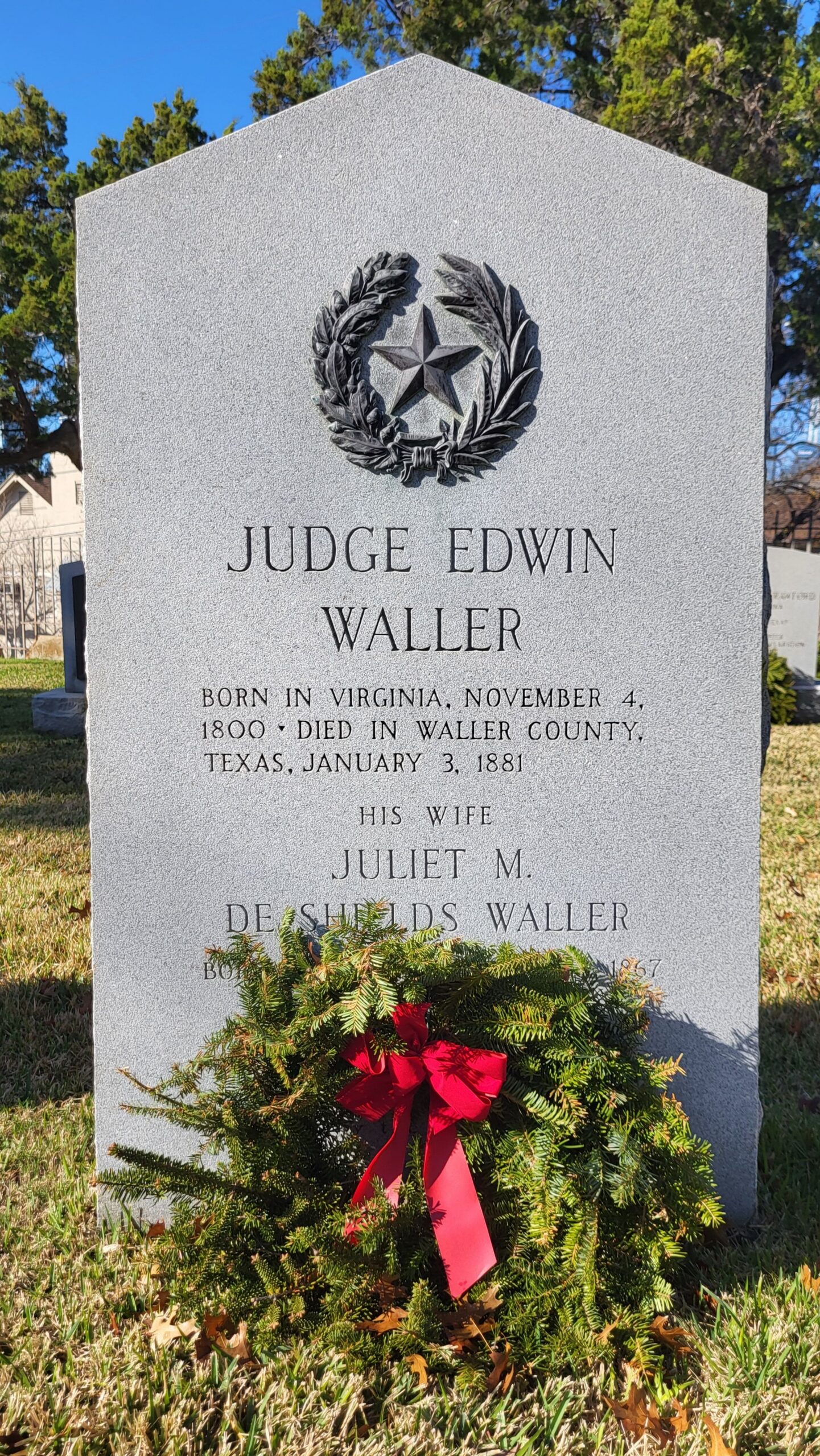
In 1873, in his honor, Waller County was created out of Austin and Grimes Counties. By then, the veterans of the Texas Revolution were being recognized, and Edwin Waller was the first president of the Texas Veterans Association. When he died in Austin on January 3, 1881, he was busy compiling names of the veterans. He was buried in the family cemetery in Waller County. However, in 1928, in recognition of his prominence in Texas history, his remains and those of his wife were reinterred in the State Cemetery in Austin. You can see his gravestone today on Patriot Hill. Let us salute Edwin Waller, feisty patriot of Texas.
In the next column, I’ll dissect Waller’s 1839 plan for the Capital of the Republic of Texas.
Sources:
Thanks to the Texas State Historical Association’s Handbook of Texas for Charles Spurlin, “Waller, Edwin Leonard,” Handbook of Texas Online, accessed December 14, 2025, https://www.tshaonline.org/handbook/entries/waller-edwin-leonard .
“Edwin Waller” in Wikipedia (https://en.wikipedia.org/wiki/Edwin_Waller)
The Portal to Texas History and its reprint of “Reminiscences of Judge Edwin Waller by P. E. Peareson,” The Quarterly of the Texas State Historical Association, Volume 4, July 1900 - April, 1901: pp. 33-54, accessed December 14, 2025. (https://texashistory.unt.edu/ark:/67531/metapth101018/m1/58/?q=Edwin%20Waller )
Martha explains her column's title:
Here's why I am calling my column “Wallering Around in Austin’s History.” Partly, it’s a tribute to Edwin Waller, the man who led the planning of Austin, and partly it’s a joke on me. All I ever seem to do is “waller” around in history, not just Austin history, but about all history. “Waller” is how we in Texas pronounce “wallow.” Like in “hog waller.” When you consult the dictionary, you see that “wallow” is a verb meaning to roll about or lie in; to luxuriate or revel in; to flounder about; to billow forth. That’s all I seem to do these days in the always-absorbing realm of what went before.