

“Angelina Eberly: Tavern Slattern or Pioneer Heroine?”
By Martha Ann Hartzog
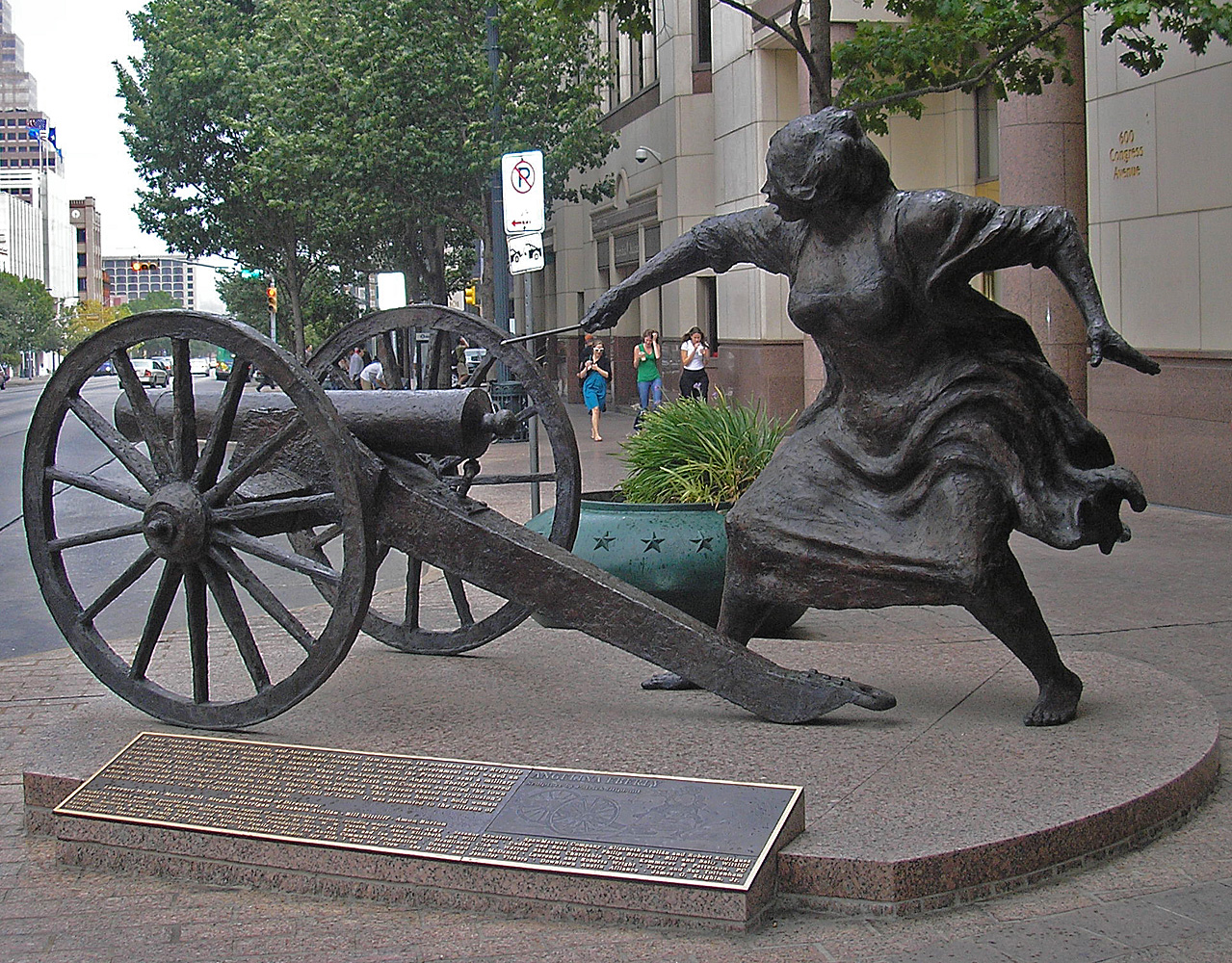
No one who walks around downtown Austin can miss the startling bronze statue of a rather robust woman about to fire off a cannon. It stands on the west side of Congress Avenue near 6th Street. It celebrates Angelina Eberly, heroine of Texas’ Archives War, who touched off a cannon to discourage Sam Houston’s crew from stealing the state archives.
In 1842, the identity of Austin as the fledgling capital of the Republic of Texas was tenuous. Sam Houston, then President, was waging a campaign to move the archives back to his namesake city, Houston. Angelina Eberly ran a prominent boardinghouse, The Eberly House, fronting on Lavaca and Pecan (now 6th) Streets. The Eberly House became known as the best boarding house in the new capital of the Texas nation.
Who was Angelina Eberly? How did she come to Austin to run a boardinghouse? Hers was an interesting journey, one quite typical of the early Anglo settlers. Angelina Belle Peyton was born in Tennessee in 1798. She married her cousin, Jonathan C. Peyton, in 1818. Like many others, they were eager to get to Texas. In June 1822, they arrived on the Good Intent, at Matagorda Bay on the Texas coast. It was only the second ship of Anglo emigrants to arrive! From Empresario Stephen F. Austin, Angelina’s husband received a grant of land in Matagorda County. By 1825, the couple had moved to San Felipe de Austin on the Brazos River. The Peytons were among the first to purchase several lots in the Empresario’s newly minted town. Here the couple set up an inn and a tavern. At the time, inns serving food in a tavern dining area were where all visitors to any town stayed. Angelina’s husband died in 1834. She continued to run the inn/tavern until the Spring of 1836, when the Texas Revolution began in earnest.
Remember the Alamo? After that siege, the Mexican Army began to move east to continue its military successes. The settlers began to flee east, too, to escape the army in what became known as “The Runaway Scrape.” The Texans burned the town of San Felipe to the ground so that the Mexicans could not occupy it. At the Battle of San Jacinto in April of 1836, the Texans prevailed over Santa Anna and his army. Texas becomes a new nation, and things settle down. At some point, Angelina moves down the Brazos River to Columbia (now West Columbia), where she marries Jacob Eberly, a widower and a veteran of the Texas Revolution.
In 1839, Angelina and her second husband arrived in Austin, now the capital of Texas. Here they purchase lots fronting on Lavaca and Pecan (now 6th) streets. The town of Austin had just been laid out and lots platted and sold by Edwin Waller. The Eberlys established and ran what became the finest boardinghouse in the capital, the Eberly House, known for its excellent food. By now, Angelina is 41 years old. When Sam Houston visited Austin at the end of December 1841, he chose to stay at the Eberly House rather than the rather rustic accommodations up Congress Avenue provided for the President of the Republic.
The next year, in 1842, the citizens of Austin became fearful that President Houston would want to move the state papers and thus the capital back to Houston, his namesake city. A vigilante committee was created. By midnight on December 30th, 1842, the Houston-ordered band had arrived in Austin, managed to load the archives in three wagons in an alley behind the Land Office, and began to rumble away. While the vigilante committee slumbered, who was awake and alert to the danger? Angelina Eberly! She marched the short distance to Congress Avenue where the small, six-pound cannon loaded with grapeshot sat, ready in case of Indian attack. She touched off the tinder to fire the cannon. It hit the Land Office Building and woke up the sleeping town. A posse quickly assembled, rode out, and recovered the archives, including the precious land records. Afterwards, the archives were sealed in tin boxes and stored at Mrs. Eberly’s with a 24-hour guard. She not only had the best boardinghouse in the city, but she also had the safest!
What happened next to this Texas pioneer and heroine? By 1847, she had moved to the up-and-coming port of Lavaca (now Port Lavaca), where she ran The Tavern House. Then it was on to Indianola, where by 1850, she was running a hotel. By this time, Indianola rivaled Galveston in importance as a port city along the Texas coast. In fact, in 1849, the Morgan Steamship line began to export beef from Indianola in refrigerated ships. Angelina was moving up!
Angelina Eberly died in Indianola in 1860, at the age of 62. This heroine of Texas was among the earliest Anglo pioneers in Texas and a highly successful businesswoman. She left her estate to her grandson, appraised at $50,000 at the time. In today’s estimates, that would represent almost $2 million dollars!
In 1842, did Angelina Eberly look like the barefoot, buxom woman, the innkeeper with a precariously low neckline, as presented in the bronze statue given to the City of Austin in 2004? Or like the idealized engraving of the lithe, elegant woman firing off the cannon in the Texas State Archives Collection? No one really knows. But we do know that those early Republic of Texas years were full of startlingly interesting characters. Sometimes they are noble, sometimes they are unruly. They are always intriguing. Usually, it’s the men who receive the most press, but there were many amazing women, too. Let’s remember Angelina Eberly as the brave, astute businesswoman that she proved to be and take “with a grain of salt” the image of her represented by the statue on Congress Avenue.
Side note! On February 26, 2026, the Austin History Center Association will host its annual Angelina Eberly Luncheon, an elegant affair, this year honoring John Henry Faulk, another hero in Texas’ pantheon. Like Angelina Eberly, John Henry strove to protect the knowledge and history of his day and time. Click here to find out more: https://austinhistory.org/event/eberly-2026/
Dear Readers, I hope you enjoy this little piece of history, as you “waller around” in Austin history with me!
Sources: In general, I rely on various articles found in The Handbook of Texas Online (www. https://www.tshaonline.org); for this article I have also used The Southwestern Historical Quarterly, Vol. 36, 1933, pp. 193-199 (both of these worthies published by the Texas State Historical Association; older issues of the Quarterly can be found in The Portal to Texas History, an on-line source published by the University of North Texas).

Martha explains her column's title:
Here's why I am calling my column “Wallering Around in Austin’s History.” Partly, it’s a tribute to Edwin Waller, the man who led the planning of Austin, and partly it’s a joke on me. All I ever seem to do is “waller” around in history, not just Austin history, but about all history. “Waller” is how we in Texas pronounce “wallow.” Like in “hog waller.” When you consult the dictionary, you see that “wallow” is a verb meaning to roll about or lie in; to luxuriate or revel in; to flounder about; to billow forth. That’s all I seem to do these days in the always-absorbing realm of what went before.