

Wallering Around in Austin’s History
By Martha Ann Hartzog
The Bat with a Golden Heart and a Bridge to a Magic Portal: Keep a bit of Whimsy in your Pocket
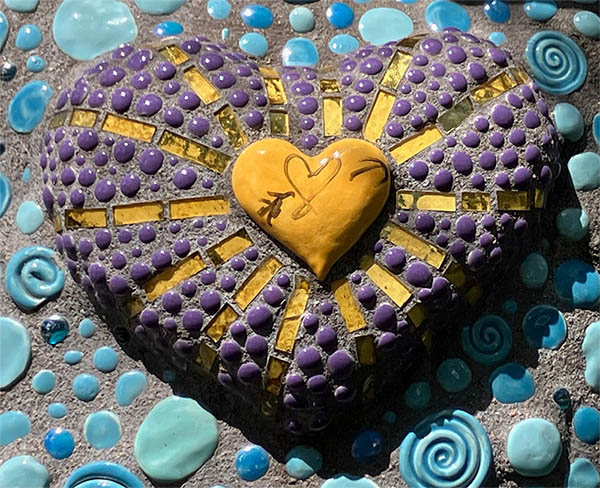
Finding myself a little lost in a series of dead-end streets in a charming South Austin neighborhood, the delightfully unexpected is encountered. A bit of lost Austin whimsy. A large bat rises up on the edge of a small park. Made of colorful mosaics and tiles, its wings are raised in greeting. It has a golden heart.
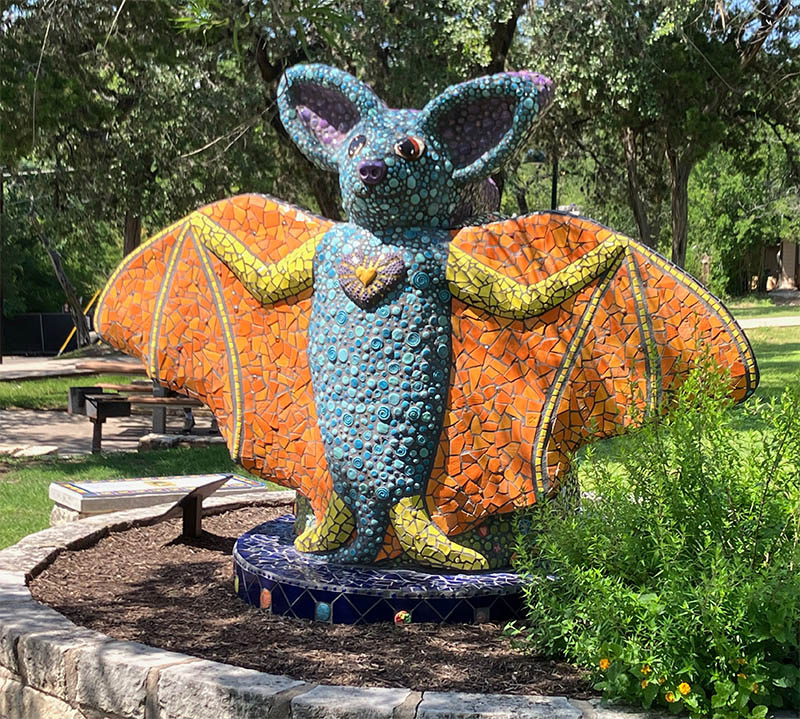
Walk around the statue and the bat with a heart cunningly morphs into an armadillo holding a football, outstretched bat wings now appearing as Monarch butterfly wings. This is a playful and serious homage to a local young man, Ricky Guerrero, who tragically died from a football accident, at the age of only 17 years. Deeply mourned, Ricky attended Austin High and was an outstanding student and a true friend to all.

Ricky’s loving parents, Roy and Tootsie Guerrero, made possible the sculpture and the naming of the Ricky Guerrero Pocket Park. The 2001 sculpture, “Corazon de Oro” (“Heart of Gold”), by artist Gigi Miller, invites viewers to look deep and let their love shine. This little gem, located at 2006 South 6th Street, is a City of Austin Pocket Park, the sculpture supported by Austin Art in Public Places.
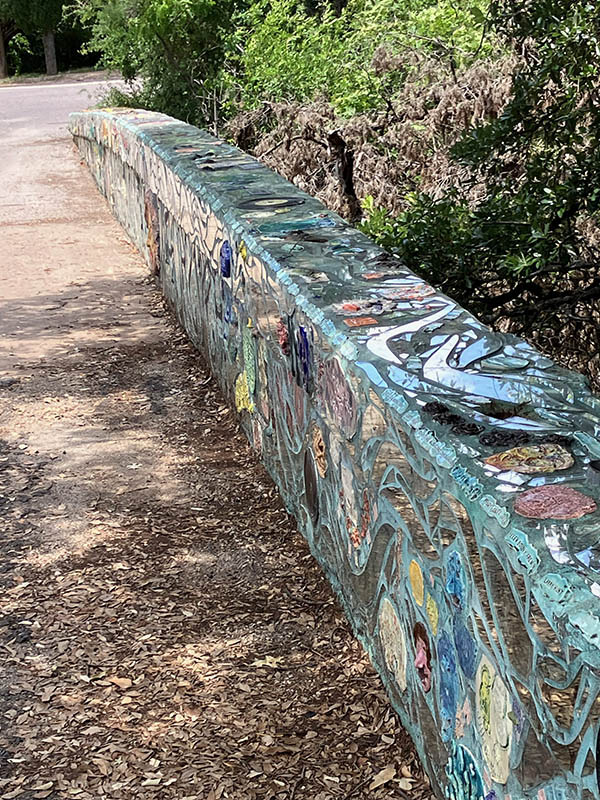
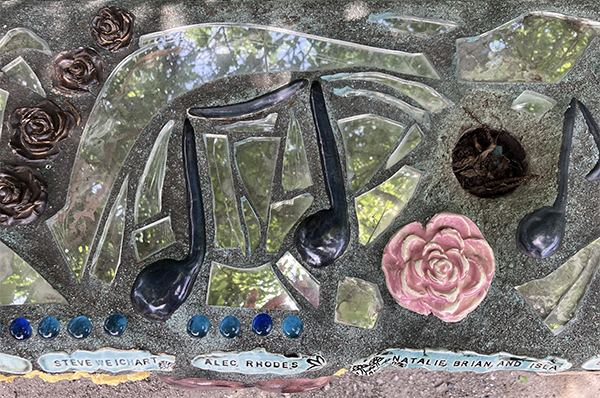
Hurrah! Whimsey is not yet dead in Austin. Near the author’s house is Little Stacy Park, with its children’s pool, playground, and tennis courts. You approach it from the south via “The Larry Monroe Forever Bridge,” a homage to a much-beloved Austinite, KUT-FM DJ and Musicologist, Larry Monroe, who sadly passed away in 2014. The humble concrete bridge has been transformed into a magic tribute by the radio artist’s fans, who adorned it with ceramics, mirrors, and “bits and bobs” appropriate to Larry’s life. The mosaic was conceived by Larry’s partner, the photographer Ave Bonar, who along with Stefanie Distefano, another artist, led a team of more than one 100 volunteers in the fabrication and installation of the bridge in 2015.
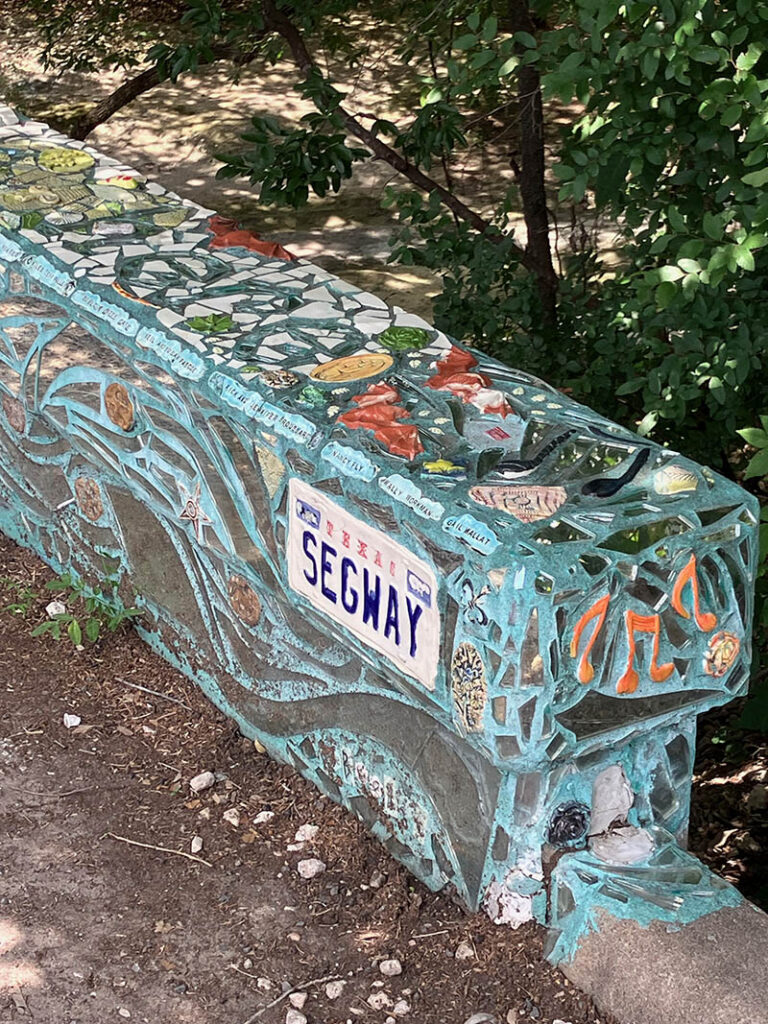
What inspired such devotion? Larry Monroe began his career at KUT-FM in 1981, with a five-night a week jazz program. He went on to create and host four beloved radio programs centered around music, particularly Texas music. The programs were “Texas Radio,” “Segway City,” “Blue Monday,” and “Phil Music.” The “Phil Music” show was a play on “fill” music: during the breaks in the City Council meetings which were brought live to the KUT-FM audience, Larry Monroe would joke that DJ Phil Music was missing and he was “filling in.” As a musicologist, Larry went on to play an important role in a documentary of singer-songwriter Townes Van Zandt and also musician Blaze Foley. The Larry Monroe Bridge is another project of the City of Austin’s Art in Public Places Collection.

Now imagine you have crossed the Larry Monroe Forever Bridge and are entering Little Stacy Park. Created in 1929, the park follows the course of Blunn Creek from Live Oak Street northwards, until the creek empties into Lady Bird Lake. On the south end is Big Stacy swimming pool. Weave along the park trail north, cross the Larry Monroe Bridge and you are in Little Stacy Park. It sits where Blunn Creek makes a wide bend on its way to the Colorado. Families are drawn to the picnic tables and the children’s wading pool. Don’t forget the ever-popular tennis court where morning “thwacks” punctuate the air.
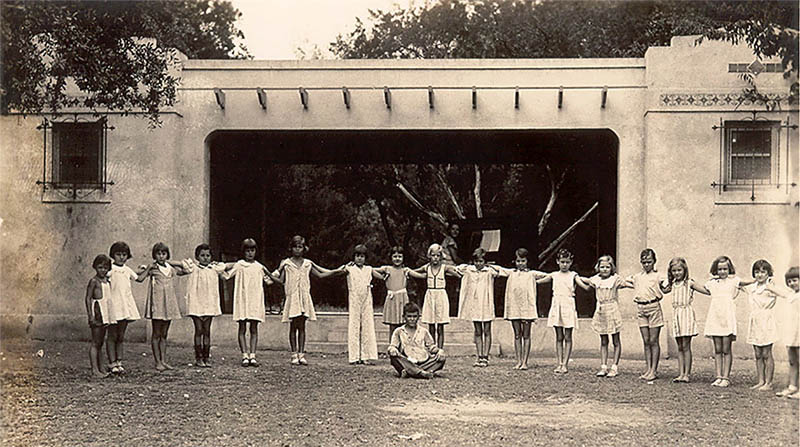
Dominating the Little Stacy landscape is a bandstand/stage designed in the Mission Revival Style. It was erected in 1930 to complement the varied architectural styles of the neighborhood. It’s used today for small concerts and drumming groups.
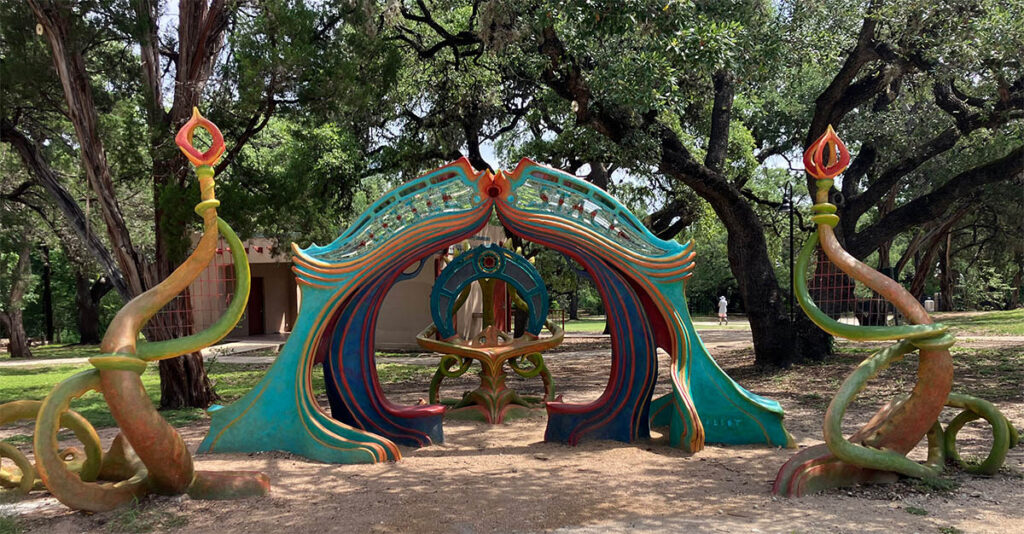
But look! When you leave the Larry Monroe Bridge, a charming fairy gate greets you, with sinuous shapes in bright colors. A “Magic Portal.” A homage by artist James Talbot to art nouveau and all the fairy stories you have ever heard, it welcomes you to enter the realm of imagination, of whimsy, if you will. Designed by James Edward Talbot in 2022, it is called “The Magic Portal.”

A bright sun draws you into the apex of the second, smaller portal. Who can resist its allure?
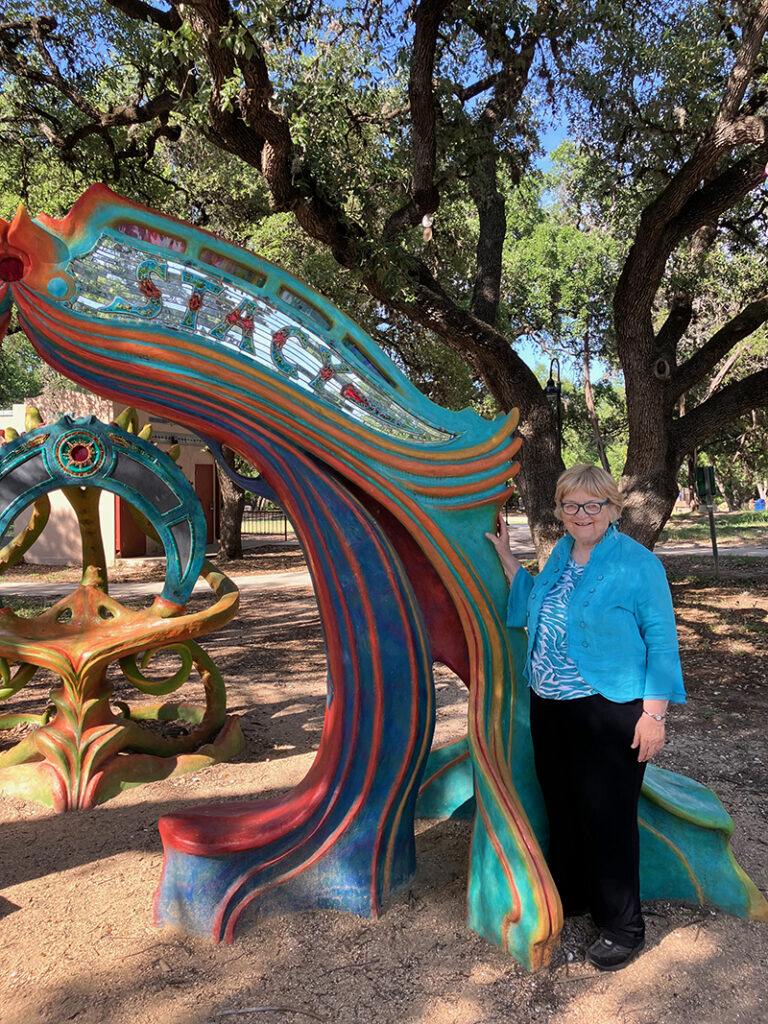
Someone who “wallers around” in Austin’s history naturally could not resist. Thank you again to the City of Austin’s program of Art in Public Places. There surely are more little whimsies, examples of capricious humor or fanciful expression, to be found in Austin, some public, some private.

A bit of private whimsy, a cobalt blue bottle tree, stands in the front yard of a Travis Heights house. Guess whose home? How many know the origin of these colorful garden ornaments, found throughout the South? Bottle trees were traditional to the Georgia and South Carolina barrier islands, home of the Gullah Geechee. The Gullah believed that the color blue would scare away evil spirits. The bottles would trap them and keep a home safe. Maybe today a bottle tree can catch both the bad spirits AND as well encourage the revival of some of the lost Austin whimsy.
In the airs of the high pecan tree boughs we hear a faint song:
“Where has all the whimsy gone?
Long time passing
Where has all the whimsy gone
Long time ago?”
Apologies to Pete Seegar and Joan Baez
Sources:
“Larry Monroe (radio personality),” Wikipedia, (htpps://enwikipedia.org/wiki/Larry_Monroe_(radio_personality)/, accessed 5/14/2026)
“Little Stacy Park,” from Greater South River City Neighborhood Plan, September 2005 (pdf) (https://historictravisheights.org/history/little-stacy-park/ accessed 5/14/2026)
“Magic Portal,”Public Art Archive. (https://publicartarchive.org/art/Magic-Portal/50d70602, accessed 5/16/26).
“Ricky Guerrero Park,” Bouldin Creek Neighborhood Association (https:www.bouldincreek.org/ricky-guerrero-park-detail/, accessed 5/14/2026)
Martha explains her column's title:
Here's why I am calling my column “Wallering Around in Austin’s History.” Partly, it’s a tribute to Edwin Waller, the man who led the planning of Austin, and partly it’s a joke on me. All I ever seem to do is “waller” around in history, not just Austin history, but about all history. “Waller” is how we in Texas pronounce “wallow.” Like in “hog waller.” When you consult the dictionary, you see that “wallow” is a verb meaning to roll about or lie in; to luxuriate or revel in; to flounder about; to billow forth. That’s all I seem to do these days in the always-absorbing realm of what went before.