

“Wallering” Around In Austin’s History
By Martha Ann Hartzog
“Edwin Waller’s Plan for a Nation’s Capital”
Because of its “salubrity of climate and its beauty of situation,” Austin will become “famous among the cities of the world.” ~ Edwin Waller
Texas’ independence from Mexico achieved, Sam Houston, the “Keenest blade at San Jacinto,” was elected President of the Republic of Texas in 1836. Edwin Waller, having played a major role in the fight for nationhood, had retired to take care of his business interests in Brazoria. By 1839, another side of Waller would emerge, “ever ready with pen or rifle.”
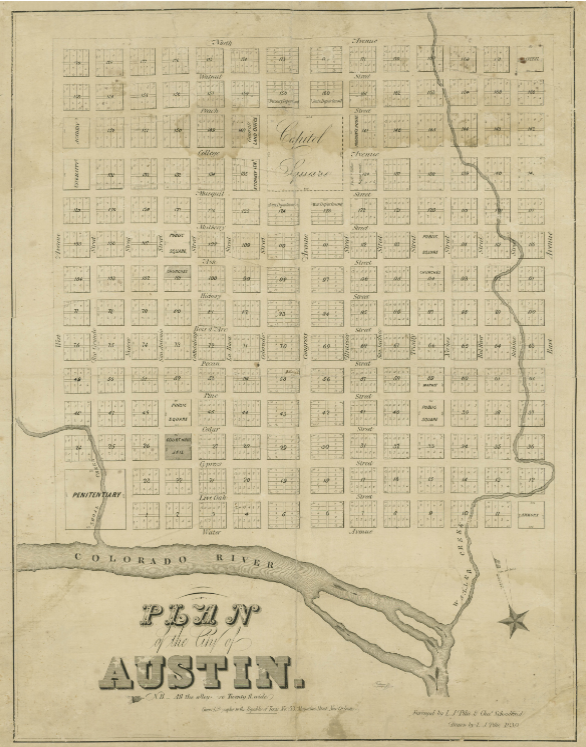
Mirabeau B. Lamar had been elected president to succeed Houston. Lamar and Waller knew each other well, having been members of what was called “The War Party,” men eager to fight for the independence of Texas. Lamar had a dream about a new “seat of empire.” He wanted the capital to be located on the banks of the Colorado, near a tiny settlement called Waterloo. He asked Waller to lay out the plan for the new capital, which was named for Empresario Stephen F. Austin. In addition, Waller was to supervise the surveying of town lots and the creation of public buildings. The resulting plan of 640 acres was a classical, logical grid, reflecting the finest principles of city planning.
The new capital would front the Colorado River. A broad avenue, a central spine, would proceed northwards from the east-west running Water Avenue, aptly named as it overlooked the river. As the seat of empire envisioned by Lamar, the avenue leading to the Capitol Square was dubbed Congress Avenue. The 14-block grid plan paid homage to Texas geography. On either side, the north-south streets would be named for the rivers of Texas, beginning with Rio Grande on the western side of the plat and ending with the Sabine on the east, just as the rivers run in Texas— later, they would be numbered. The cross streets moving east and west would be named for the trees of Texas. Today, only 6th Street, also known as Pecan Street, retains the memory of these trees. If you want to see the original names, consult Waller’s plan online and enlarge the elegantly drawn image. The city is bounded by West Avenue, East Avenue, North Avenue, and Water Avenue. Shoal Creek runs through the southwest corner, and Waller Creek meanders along the entire east side. The northernmost street, above the Capitol block, was named North Avenue.
In addition to the overall city plan, Waller was asked to survey the lots in each block and to construct buildings to house the main departments of the nation. Congress Avenue was interrupted at 11th St. for a spacious square called Capitol Square, where ultimately the state capitol of the mighty nation would rise up. As a temporary measure, a simple Capitol building was erected on the corner of Colorado and 8th Streets.
Edwin Waller and his associates were trying to provide for everything a national capital might need. Circling the Capitol Square are spaces for Attorney, En (engineer?), Land Office, War Department, Navy Department, Treasury Department, State Department, President’s House, and Post Office.
It was a grand vision! A bustling civic life was anticipated— with churches, four public squares, a market, a jail, and so forth. The public squares were south of the Capitol Square, two on each side of Congress Avenue. Very balanced. Two of them, both to the west of Congress Avenue, are recognizable today. Between Ash (9th) and Mulberry (10th), San Antonio and Guadaloup (so originally spelled), is a beautiful, recessed area with a charming gazebo at its center that is now called Wooldridge Square Park. Four blocks south of that is Republic Square, between Cedar (4th) and Pine (5th), where the first 306 lots of the new capital were auctioned on August 1, 1839, under, appropriately, the still-standing Auction Oaks.
Across the street from Wooldridge Square, just south, is a half block called Churches. That’s where the (thankfully preserved) 1933 Kuehne Building, originally housing the Austin Public Library and then the Austin History Center, now stands. The pattern of a public square with a church across the street was repeated on the east side of Congress. There are other interesting details to be found on this lovely plan.
Indian raids were a constant danger for both the citizens and the survey party. In one instance, the survey party was camped by Waller Creek when a band of Indians swooped down and took scalps from some of the workmen. Waller’s employees were described as “wild characters,” who were “turbulent and restless under control.” Besides the relentless summer heat, the workers had to deal with scarce materials and provisions. They survived on beef, cornbread, and spring water. The public buildings were made of local planks and logs, but were serviceable. The house where the President of the Republic lived was not the Greek Revival Governor’s Mansion we know today, but a much simpler structure on Congress Avenue. Waller’s own home was on the northwest corner of Mulberry (now 10th St.) and Congress. Legendary innkeeper Angelina Eberly and her husband purchased lots on Lavaca and Pecan (6th Street).
The work began in May and was finished in November. The government gave Waller a bond to finish his task, in the sum of $100,000 (the equivalent of $7 million today). Against all odds, Waller and his crew managed to complete their job on time and on budget! Something apparently unheard of in today’s world.
With great fanfare, on October 17th, President Lamar arrived with an entourage to see the work virtually accomplished. One fourth of the town lots had already been sold for a total amount that enabled the construction of public buildings! In his welcoming address, Edwin Waller predicted that because of its “salubrity of climate and its beauty of situation,” Austin would become “famous among the cities of the world.” Was he prescient?
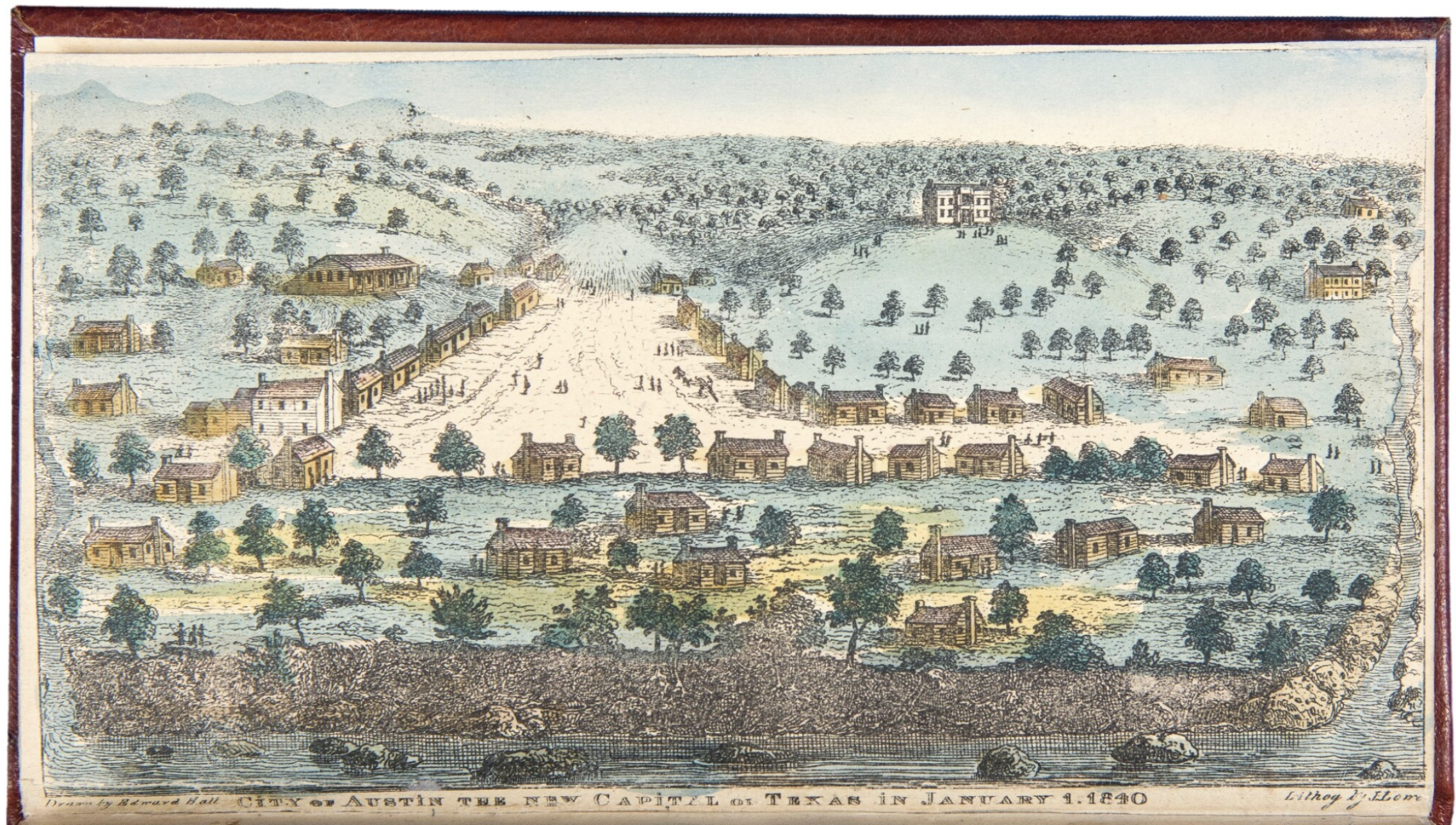
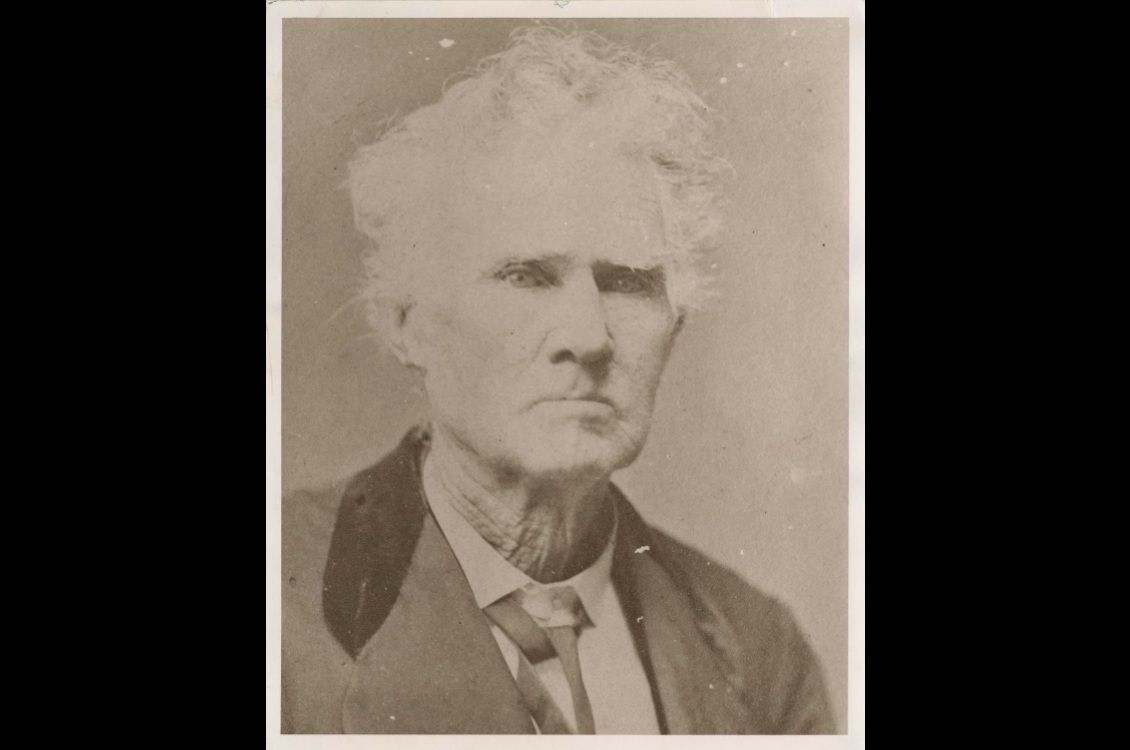
Progress after this proceeded slowly. Compare the published 1839 Plan of the City of Austin with the drawing of what Austin actually looked like in 1840. Let’s also not forget that photo of Edwin Waller as an old man. Deep-set eyes and a determined set of the jaw reveal what he must have looked like in his youth. “Ever ready with pen or rifle!”
Sources:
The Portal to Texas History reprint of “Reminiscences of Judge Edwin Waller by P. E. Peareson,” The Quarterly of the Texas State Historical Association, Volume 4, July 1900 - April, 1901: pp. 33-54, accessed December 14, 2025. (https://texashistory.unt.edu/ark:/67531/metapth101018/m1/58/?q=Edwin%20Waller )
Other sources include the Texas Britannica, our own handy online source, the Handbook of Texas (https://www.tshaonline.org/), published by the Texas State Historical Association, a non-profit founded in 1897.
“Edwin Waller” in Wikipedia (https://en.wikipedia.org/wiki/Edwin_Waller)
Also, historian Stephen L. Hardin has written an account of those days with easily digestible short chapters, aptly called Lust for Glory, published by State House Press and available on www.amazon.com .
Martha explains her column's title:
Here's why I am calling my column “Wallering Around in Austin’s History.” Partly, it’s a tribute to Edwin Waller, the man who led the planning of Austin, and partly it’s a joke on me. All I ever seem to do is “waller” around in history, not just Austin history, but about all history. “Waller” is how we in Texas pronounce “wallow.” Like in “hog waller.” When you consult the dictionary, you see that “wallow” is a verb meaning to roll about or lie in; to luxuriate or revel in; to flounder about; to billow forth. That’s all I seem to do these days in the always-absorbing realm of what went before.