

Wallering Around in Austin’s History
By Martha Ann Hartzog
Here’s why I am calling my column “Wallering Around in Austin’s History.” Partly, it’s a tribute to Edwin Waller, the man who led the planning of Austin, and partly it’s a joke on me. All I ever seem to do is “waller” around in history, not just Austin history but just about all history. “Waller” is how we in Texas pronounce “wallow.” Like in “hog waller.” When you consult the dictionary, you see that “wallow” is a verb meaning to roll about or lie in; to luxuriate or revel in; to flounder about. That’s all I seem to do these days in the always-absorbing realm of what went before.
Untold stories with complicated relationships abound in all of history. The city of Austin and the State of Texas are no exceptions. Take the Holland brothers, for example: William H. Holland (1841-1907) and Milton Murray Holland (1844-1910), along with their father, Bird Holland (1815-1864).
The lives of these three Holland men reflect the complicated relationships of the 19th century. Bird Holland came to Galveston, Texas, apparently in the 1830s, from Tennessee. By 1840, he was in Austin, Texas. His older brother, Spearman Holland (1802-1872), arrived in Texas via Mississippi in 1842, where he established a plantation near Marshall, Texas.
Bird Holland had a long-time relationship with Matilda Beck, an enslaved woman who lived near Marshall at the plantation of Bird’s older half-brother, Spearman. This relationship produced a number of children from the time Bird arrived in Texas until 1852, a period of over twenty years. Laws would have prohibited him from marrying the enslaved mother of his children. Prior to 1860, two of the sons that the union produced—William and Milton— were freed by Bird Holland (in a process called “manumission”) and sent to be educated at the Albany Manual Labor Academy in Ohio. From about 1850 to 1863, Albany, Ohio, served as an important station on the Underground Railroad. At the time, the town was a regional educational hub as well as a safe place for free Black Americans. The Academy accepted African American students, and this is where Bird Holland placed his sons and paid for their education.
Bird Holland had a prominent career in Texas. He served in the Mexican War (1846-1848), as captain of Company F., part of Col. George T. Woods Second Regiment. After the Mexican War Bird Holland served as chief clerk and assistant secretary in the Texas State Department. In 1858, he married Matilda Rust in Austin, but she died, possibly in childbirth, the same year. Texas passed the Declaration of Secession February 1, 1861. Bird Holland was appointed Secretary of State on March 16, 1861. He served until November, 1861, for only nine months, until he joined the Confederate Army in the great struggle known as the American Civil War.
Bird’s two sons, living now in Ohio at the Albany Institute, would join the federal army, as part of what was called the United States Colored Troops (USCT). The older of the two sons, William H. Holland, about 20 years old when the war broke out, joined the Sixteenth United States Colored Troops (USCT), organized in Nashville, Tennessee, but including Ohio men. William H. participated in the battles of Nashville and Overton Hill in Tennessee and in the pursuit of John Bell Hood to the Tennessee River. (Interestingly, this author had two great grandfathers and three great-great uncles who served in Hood’s Texas Brigade, a Confederate unit.)
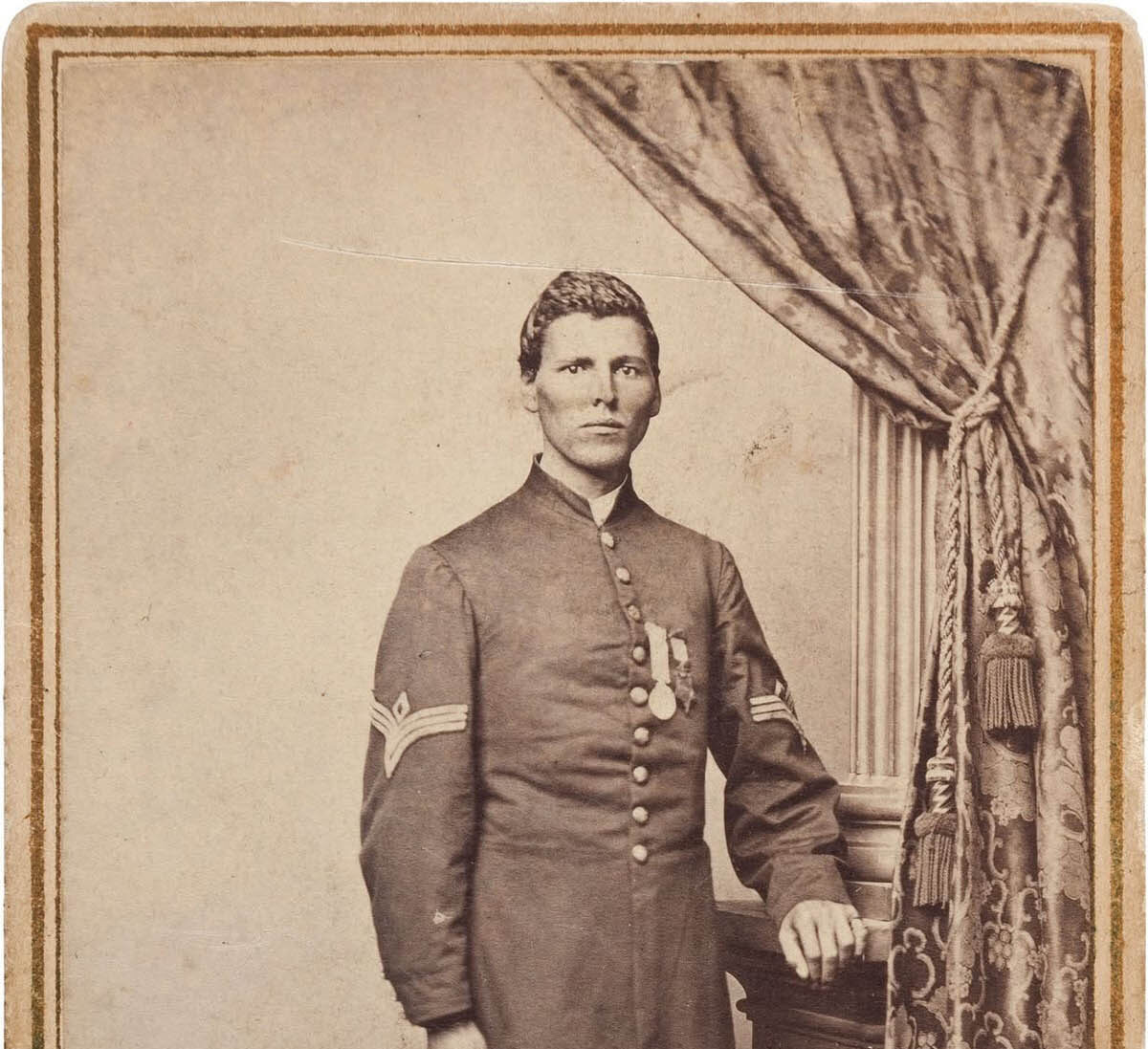
William H.’s brother, Milton M., only 17 in 1861, was a little too young to enlist when the war broke out and worked as a shoemaker for the Quartermaster Department of the Army. He had probably learned that trade at the Albany Manual Labor Academy. In June 1863, he joined the Fifth United States Colored Troops in Athens, Ohio. His leadership qualities were obviously recognized as he rose to the rank of Regimental Sergeant Major. He fought in the famous Battle of the Crater, in Virginia.
In September, 1864, During the engagements at Chaffin’s Farm and New Market Heights, near Richmond, Virginia, the Confederate Capital, various units of the USCT were called into action. USCT units were led by White commanding officers. At New Market Heights, all of the White officers were killed or wounded. Milton Holland assumed command and led the Black troops in battle. They fought heroically. The casualties were enormous, with the USCT losing one of every three men. On April 6, 1865, the Congressional Medal of Honor was awarded to fourteen African Americans who were engaged in the offensive. Sergeant Major Milton Holland was one of the recipients and the first African American born in Texas to receive a Congressional Medal of Honor.
While one son was fighting in the Union Army and the other waiting until he was old enough to join, Bird Holland joined the Confederate Army, serving as adjutant for Colonel Richard B. Hubbard’s Twenty-second Texas Infantry. The Twenty Second was part of Walker’s Texas Division. “Walker’s Greyhounds,” so named because of the long marches they endured, saw action in Arkansas and Louisiana. These states, along with Texas, were part of the Trans-Mississippi Department, comprising the states west of the Mississippi River. In April of 1864, the Union forces, under General Nathaniel Banks were moving north in Louisiana in an attempt to invade Texas from the Shreveport area with the goal of taking over Texas’ valuable cotton and beef production. Walker’s Greyhounds were sent from Arkansas down to Louisiana to be part of the Confederate defense of Texas. At the Battle of Mansfield on April 8th, while leading his regiment, Captain Bird Holland was killed. His body was identified among the fallen, and the following year, it was returned to Austin. He lies now in Oakwood Cemetery.

The Post War Years saw successes for both of Bird Holland’s sons. In 1867, William H. entered Oberlin College in Ohio, attending for two years. He then returned to Texas, where he emerged as a prominent leader in the movement for the rights of African Americans. He taught school in various counties, including a free school in Austin. He was appointed to a position at the Austin post office. In 1873, he served as a delegate for a Colored Men's State Convention gathered at Brenham, led by a Republican party leader.
In 1876, at the end of Reconstruction, William H., then a teacher in Wharton County, won election to the Fifteenth Legislature as a representative from Fort Bend, Waller, and Wharton Counties, serving three years. During his legislative term, he sponsored the bill providing for Prairie View Normal College (now Prairie View A&M). He was a delegate to the Republican national convention in 1876 and again in 1880.
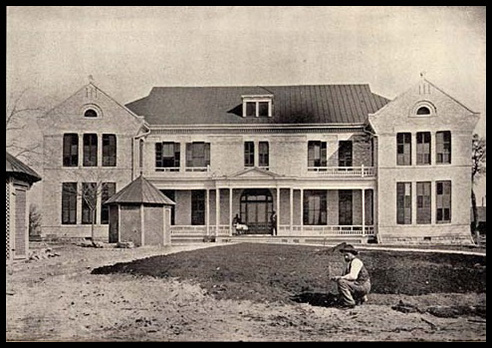
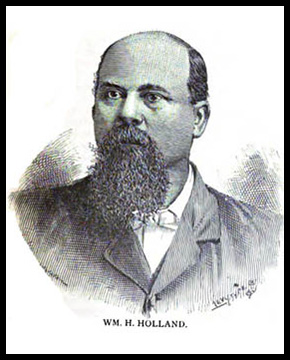
William H. Holland was instrumental in the 1887 establishment of the original Deaf, Dumb, and Blind Institute for Colored Youth. Governor Lawrence S. Ross appointed Holland to be its first superintendent on August 15, 1887. He served in that capacity for ten years, and then served again from 1904 until 1907. He died in Mineral Wells on May 27, 1907, and is buried in Oakwood Cemetery, here in Austin, the same cemetery as his father. In 2018, the City of Austin changed the name of Jeff Davis Avenue to William Holland Drive.
Milton M. Holland moved to Washington, D.C. not long after the war ended, where he worked in the United States Treasury Department. He later became Chief of Collections for the Sixth District. He studied law at Howard University and worked in banking and insurance. He was a founder of the Alpha Insurance Company, one of the first African-American owned insurance companies. He died in 1910, at his farm near Silver Springs, Maryland. He is buried at Arlington National Cemetery, in Washington, D.C., as befits a Medal of Honor winner.
There are so many questions embedded in this complicated story. What prompted Bird Holland to free his sons and pay for their education in Ohio? It was not uncommon for enslaved persons to be granted their freedom due to ties of blood or sentiment or for services rendered, but it was still a difficult process. Provision for the young men’s education was a further testament to Bird’s hopes for them. What did Bird’s wife Matilda Rust think about his children by a woman also named Matilda? What did Bird think about his sons joining the Union Army? What did his sons think about their father? What did Matilda Beck, the mother of his many children think about Bird Holland? Many of his descendants through Matilda Beck do not hold him in high regard.
Contemporaneous memoirs and letters are needed to unlock these secrets. But the story suggests that a caring father prepared his sons for freedom and that these efforts bore fruit with high achievements by both sons. The story of the Holland brothers is a success story.
Sources:
“The Battle of Chaffin’s Farm and New Market Heights.” American History Central. https://www.americanhistorycentral.com/entries/battle-of-chaffins-farm-and-new-market-heights/
Find-a-Grave entries for Bird Holland, Milton Holland and William Holland www.findagrave.com
Handbook of Texas Online: entries for Bird Holland; Milton Holland; William Holland, Spearman Holland, https://www.tshaonline.org/handbook/entries/
Markin, James W., “Texas Blind, Deaf, and Orphan School,” Handbook of Texas Online, accessed September 20, 2026, https://www.tshaonline.org/handbook/entries/texas-blind-deaf-and-orphan-school/
“Medal of Honor Valor Trail,” Bio and photograph of Milton M. Holland. American Battlefield Trust’s Post, February 23, 2026, https://www.facebook.com/americanbattlefieldtrust/posts/medal-of-honor-recipient-milton-holland/ (accessed 9/20/26).
“William H. Holland,” The Legislative Reference Library of Texas, www.lrl.Texas.gov/legalleaders/members